
How Institutions of Higher Learning Can Use People Counting to Optimise Classroom Space and Reduce Energy Costs
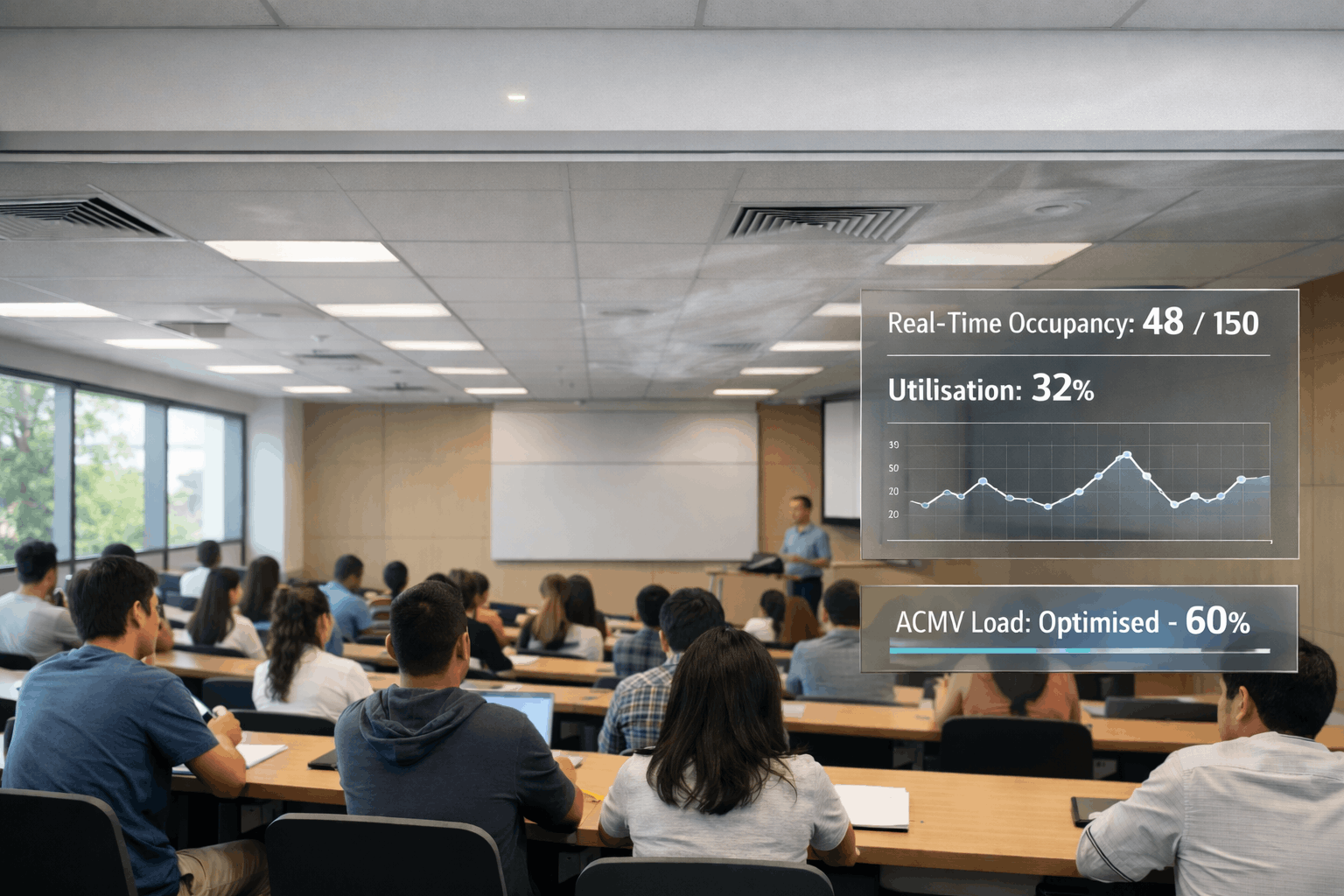
Institutions of Higher Learning (IHLs) — including universities, polytechnics, and large tertiary campuses — operate complex environments with significant space and energy demands. Rising operational costs, sustainability targets, and evolving student behaviours make it increasingly difficult to rely on static timetables and assumptions.
Accurate, real-time occupancy data provides a more reliable foundation for decision-making.
Deploying the Milesight VS135 people counting sensor, integrated with NexAscent’s analytics platform, enables IHLs to optimise classroom utilisation and reduce energy waste with measurable impact.
What Is the Milesight VS135?

The Milesight VS135 is a dual-lens AI-powered people counter designed for bidirectional traffic monitoring. Installed above classroom or lecture hall entrances, it provides:
- People entering counts
- People exiting counts
- Real-time occupancy levels
- Historical usage trends
The device processes counting locally and does not store identifiable facial information, making it suitable for privacy-sensitive educational environments.
Why Occupancy Data Matters for Large Campuses
Most IHLs estimate room utilisation based on timetables or booking systems. However, scheduled capacity frequently differs from actual attendance.
Common operational gaps include:
- A 150-seat lecture hall averaging 50 students.
- A 25-seat seminar room consistently exceeding comfortable capacity.
- Rooms booked but not utilised.
- Air-conditioning systems running at full load regardless of occupancy.
Without reliable data, space allocation and energy optimisation decisions remain assumption-driven.
Practical Use Cases in Institutions of Higher Learning
- Right-Sizing Classrooms Across Campus
Consider a polytechnic campus with:
- 12 lecture theatres (100–200 seats)
- 30 tutorial rooms (20–40 seats)
After three months of occupancy tracking using VS135 sensors:
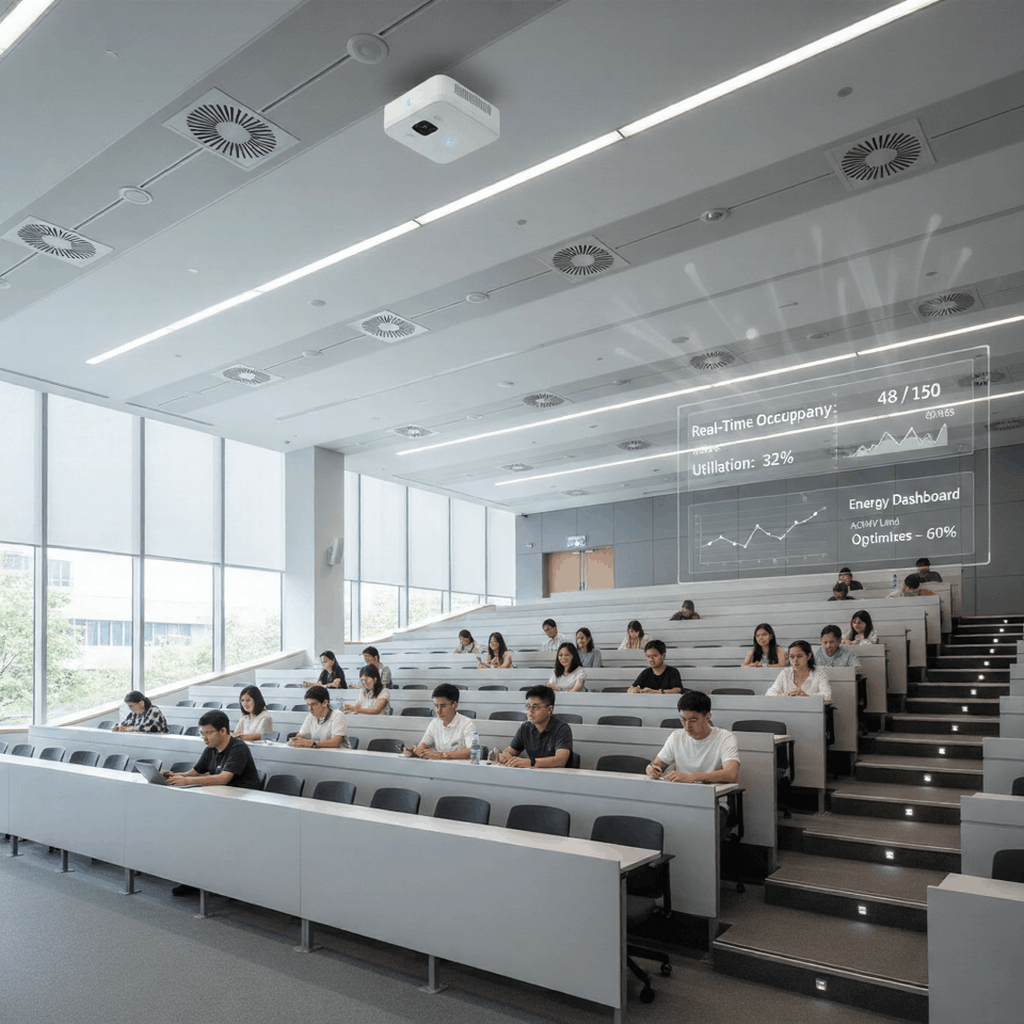
Findings:
- Lecture theatres operate at 30–40% average occupancy.
- Specific seminar rooms exceed 100% occupancy during peak hours.
- Friday afternoon utilisation drops below 25%.
Strategic Actions:
- Reassign high-demand modules to appropriately sized spaces.
- Convert underutilised large halls into hybrid or flexible learning spaces.
- Optimise timetable distribution across weekdays.
The result is improved learning comfort, better space efficiency, and reduced pressure for unnecessary building expansion.
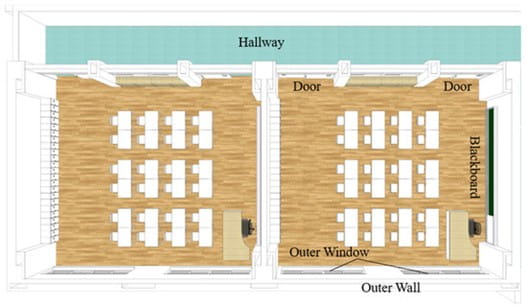
Typical classroom layout with entrances and exits
- ACMV Optimisation and Energy Savings
In Singapore, cooling demand forms a major portion of campus electricity consumption. Air-Conditioning and Mechanical Ventilation (ACMV) systems often operate based on fixed schedules rather than real occupancy.
By integrating VS135 occupancy data into the Building Management System (BMS), cooling output can be dynamically adjusted.
Example Scenario
A 150-seat lecture theatre designed for full occupancy:
- Average actual attendance: 55 students.
- ACMV currently operates at 100% cooling load.
With occupancy-based control:
- Below 30% occupancy → reduce chilled water flow or fan speed.
- 30–70% occupancy → operate at partial cooling load.
- Above 70% occupancy → full cooling capacity.
Even a conservative 15–25% reduction in ACMV energy consumption per classroom can translate into substantial annual savings across a large campus.
Beyond cost savings, this supports carbon reduction goals and Green Mark sustainability objectives.
- Data-Driven Campus Expansion Planning
Before committing to new academic blocks, IHLs can use actual utilisation data to:
- Validate real peak congestion periods
- Identify chronic underutilisation
- Model space demand based on enrolment growth
This enables:
- Evidence-backed capital expenditure decisions
- Stronger funding justifications
- Reduced risk of overbuilding
Occupancy analytics transforms campus planning into a measurable, data-led process.
Privacy and Compliance Considerations
Educational institutions require strong data governance.
The VS135:
- Does not perform facial recognition
- Does not store personally identifiable information
- Transmits only aggregated numerical data
This ensures compliance with institutional privacy policies while still delivering actionable insights.
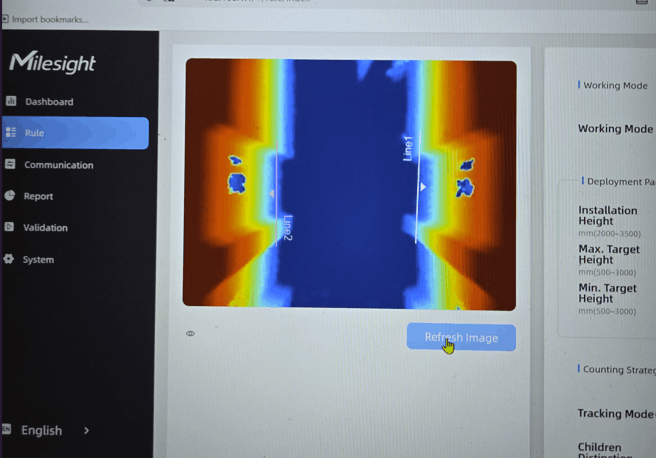
How NexAscent Enhances Deployment
Technology alone does not create value — analytics and integration do.
NexAscent provides:
- Real-Time Occupancy Dashboard
- Live classroom occupancy
- Peak-hour utilisation heatmaps
- Semester trend analysis
- ACMV Optimisation Insights
- Identification of persistently underutilised spaces
- Suggested cooling load adjustment thresholds
- Monthly efficiency reporting
- Management-Level Reporting
- Campus-wide utilisation summaries
- Department-level comparisons
- Sustainability-ready documentation
The objective is operational clarity, not merely sensor deployment.
Implementation Best Practices
To ensure accurate counting:
- Install one VS135 above each classroom entrance. With the wide detection area of VS135 and ceiling height of 3m, it is possible to monitor 2 doors.
- For rooms with multiple entrances, deploy multiple units and consolidate the counts.
- Conduct initial calibration to ensure directional accuracy.
- Integrate occupancy thresholds into the BMS for automated ACMV adjustments.
Deployment is minimally disruptive and scalable across large campuses.
Strategic Advantages for Institutions of Higher Learning
Adopting occupancy analytics enables:
- Optimised classroom allocation
- Reduced ACMV energy expenditure
- Improved capital planning decisions
- Stronger sustainability positioning
- Enhanced student experience
Institutions relying solely on booking data operate with limited visibility. Real-time occupancy data provides measurable, defensible insights for decision-makers.
Conclusion
For Institutions of Higher Learning managing large, cooling-intensive campuses, accurate people counting is not just a facilities enhancement — it is a strategic tool.
The Milesight VS135, integrated with NexAscent’s analytics platform, enables data-driven optimisation of classroom space and ACMV operations.
In a cost-conscious and sustainability-focused environment like Singapore, occupancy intelligence provides the clarity required to optimise space, reduce energy waste, and make informed long-term decisions.
