NexAscent Floor Intelligence Sensor
Introducing the NexAscent Floor Intelligence Sensor: Smart Detection for Safer, Smarter Facilities
Available Q3 2026 | NexAscent Pte Ltd
Wet floors are one of the most persistent and underestimated hazards in commercial facilities. According to workplace safety statistics, slip-and-fall incidents account for a significant proportion of injuries in shopping malls, airports, hotels, and care homes — and the majority occur within minutes of a spill, before any staff member is even aware of the problem. Traditional approaches rely entirely on human observation: a cleaner walks past, notices the spill, and responds. In busy, high-footfall environments, that window of exposure can be long enough to be dangerous.
NexAscent has built a better answer. We are proud to introduce the NexAscent Floor Intelligence Sensor — a compact, edge-intelligent IoT device that continuously monitors floor conditions and detects fallen persons, delivering real-time actionable states to facilities management teams without requiring camera footage, cloud inference delays, or complex infrastructure.
What the Sensor Does
The NexAscent Floor Intelligence Sensor classifies floor conditions and human states into four clearly defined outputs:
- Dry — floor is clear and safe
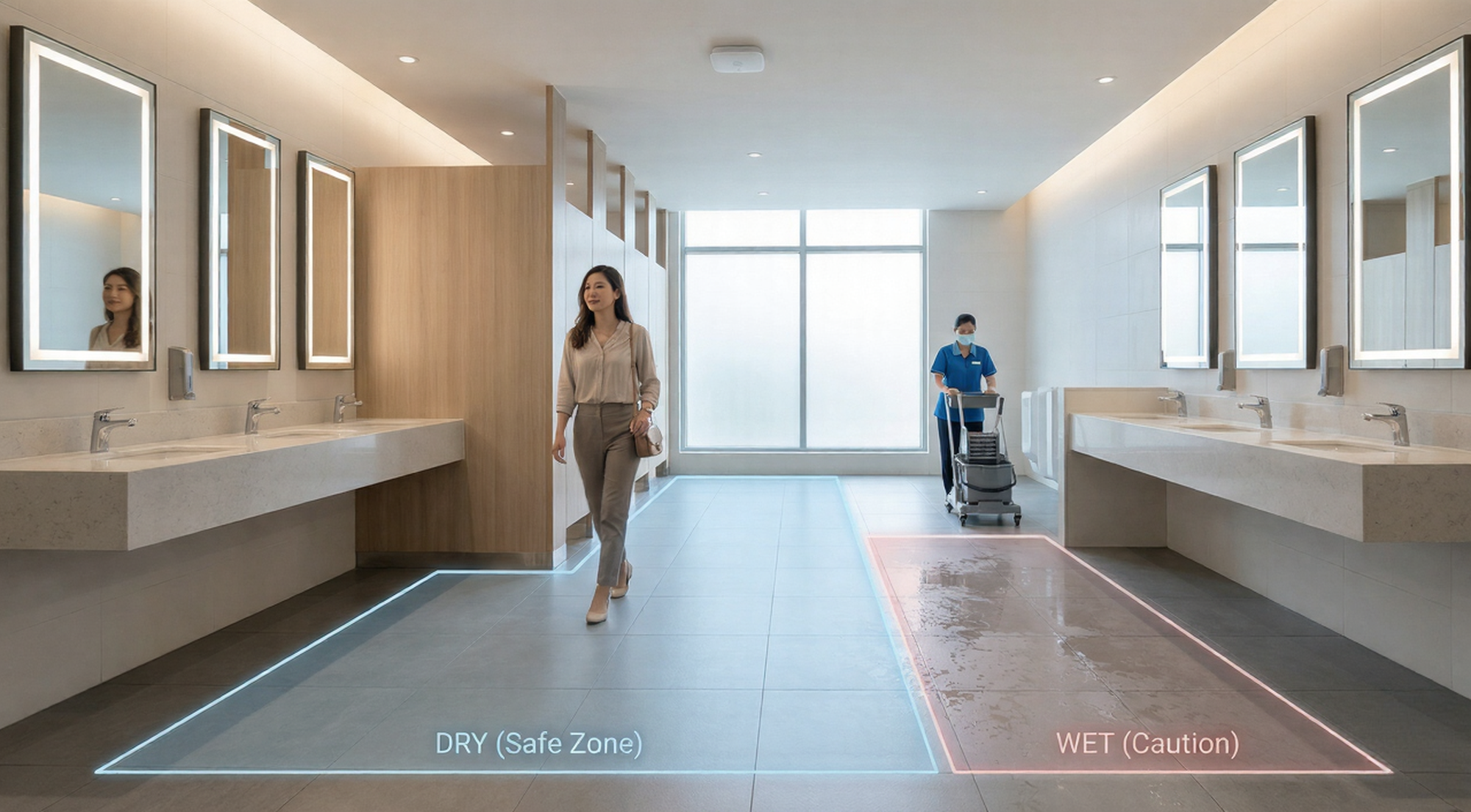
- Wet — liquid is present on the floor surface
- Mopped — floor is intentionally wet from cleaning activity
- Person Fallen — a person is detected on or close to the floor in a position inconsistent with normal movement
These four states are determined entirely on-device, using a machine learning model running at the edge. No video feed is transmitted. No cloud round-trip is required. The system acts in seconds.
The Technology Inside
At the core of the sensor is a high-resolution micro thermal imaging module — a long-wave infrared camera that captures heat signatures rather than identifiable images. Unlike visible-light cameras, the thermal imager sees the world in temperature, not colour or detail. This means the sensor can detect the presence and posture of a person, or the thermal contrast of a wet floor surface, without recording any personally identifiable visual data.
The thermal module delivers a full-array temperature map of the monitored zone, enabling the on-device ML model to distinguish between a dry tile, a water puddle, a freshly mopped surface, and a person lying on the ground — with a high degree of reliability and near-instantaneous response.
The device integrates three wireless communication layers to suit different deployment architectures:
- Wi-Fi — for facilities with existing network infrastructure, enabling direct dashboard connectivity
- LoRaWAN — for long-range, low-power deployments across large floor areas such as warehouses, exhibition halls, or multi-level carparks
This multi-radio architecture means the sensor is deployable in virtually any commercial facility, regardless of existing infrastructure. The device is powered via USB-C at 5V DC, simplifying installation and eliminating the need for custom power cabling.
Why Thermal Imaging — and Why Edge ML
The choice of a thermal imager over conventional approaches is deliberate and carries meaningful advantages.
Privacy by design. Thermal imaging does not capture faces, clothing, or any identifiable features. This is a critical consideration for deployments in restrooms, changing rooms, senior care facilities, and any environment where occupant privacy is a non-negotiable requirement.
Lighting independence. Visible-light cameras fail in low-light conditions. Thermal sensors operate equally well in complete darkness, making them suited for corridors, storerooms, and overnight monitoring without supplemental lighting.
Noise immunity. Thermal contrast between a wet floor and a dry floor is reliably detectable even in visually complex environments — chequered tiles, reflective surfaces, or variable ambient lighting do not degrade performance.
Running the ML inference on-device rather than in the cloud eliminates latency, removes dependence on internet connectivity, and ensures the sensor continues to function during network outages. The states it outputs are lightweight — a single enumerated value — making transmission over LoRaWAN practical within standard payload constraints.
Real-World Benefits for Facilities Management
Immediate incident prevention. When the sensor detects a wet floor or a fallen person, an alert is triggered instantly to the facilities management team via the connected dashboard or Telegram notification. Staff can respond within minutes rather than waiting for the next scheduled walkthrough.
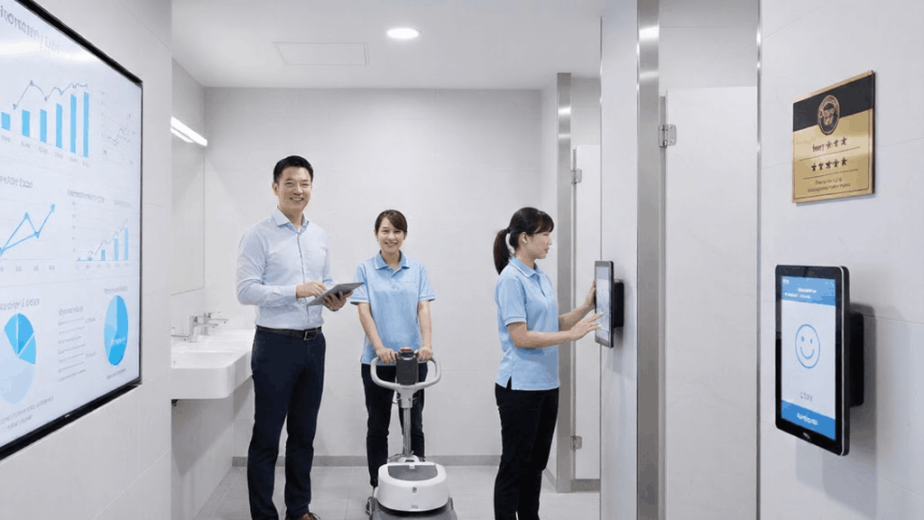
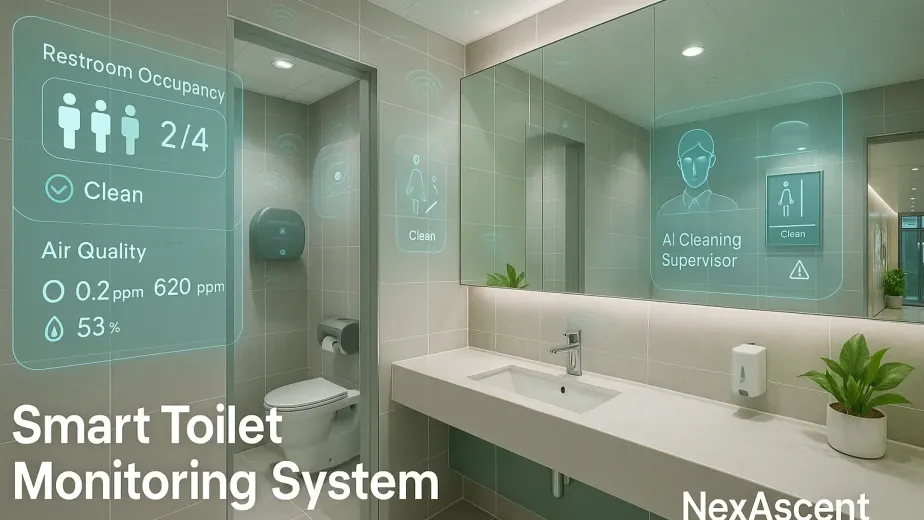
Smarter cleaning workflows. By distinguishing between “wet from spillage” and “wet from mopping,” the sensor allows facilities teams to close the loop on cleaning activities. Supervisors can verify that mopping has occurred in the correct location and time window — without relying on manual sign-off sheets. For facilities already using NexAscent ToiletOps — our smart washroom monitoring portal — the Floor Intelligence Sensor provides a natural extension of that hygiene visibility beyond the cubicle and into the common washroom floor area, creating a unified view of washroom condition and cleanliness compliance.
Audit trail and compliance. Every state change is timestamped and logged. This creates an objective record of floor conditions across time, which is valuable for insurance purposes, regulatory audits, and demonstrating due diligence under the Workplace Safety and Health Act in Singapore.
Coverage at scale. A single sensor covers a defined floor zone. Deployed in a grid pattern across a large retail floor, airport terminal, or logistics facility, they provide continuous coverage that no team of human cleaners can match consistently during peak hours.
Care home and senior facility applications. The fallen person detection capability has direct relevance in eldercare settings, where undetected falls represent a critical risk. Combined with NexAscent SafeCare — our LoRaWAN-based monitoring and emergency response platform for handicapped toilet cubicles and senior care facilities — the Floor Intelligence Sensor can form part of an integrated monitoring solution covering both common areas and individual care spaces. SafeCare already delivers real-time alerts via Telegram and email for panic button activations and occupancy anomalies; the Floor Intelligence Sensor extends that coverage to the floor itself.
Note on fallen person detection: This feature is designed as an early-warning aid to support faster human response, not as a certified medical or safety alarm system. Detection accuracy is subject to mounting height, floor zone geometry, and environmental conditions. NexAscent recommends pilot validation in each target environment prior to full deployment. This feature should not be used as the sole safeguard in high-risk care settings.
Beyond the Floor: Broader Applications of Thermal Intelligence
While floor wetness and fall detection are the primary use cases, the underlying thermal sensing and edge ML platform opens the door to a wider range of monitoring applications. The same device, reoriented or reconfigured, can serve meaningfully different purposes across a facility.
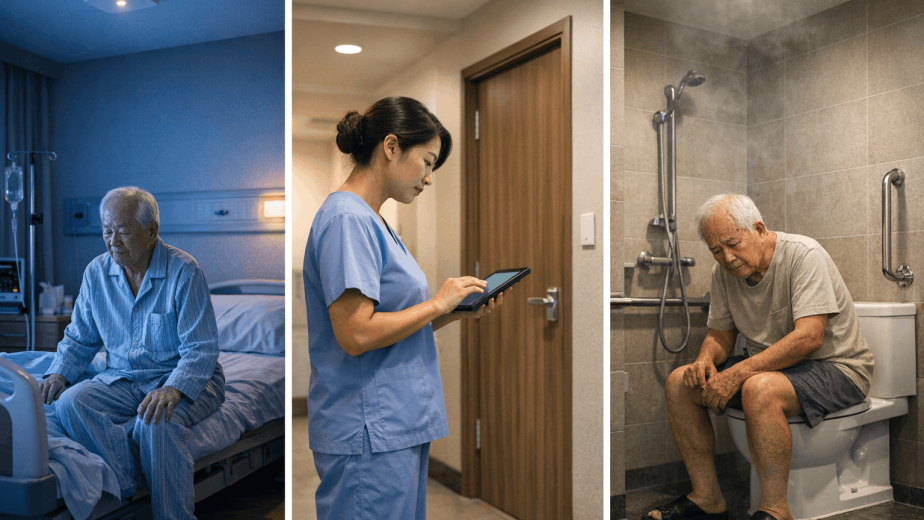
Bed occupancy and patient monitoring. Mounted above a bed in a care home, ward, or residential room, the sensor can detect whether a patient or resident is present in bed, has left the bed unassisted, or has fallen beside it. For night-time monitoring where staff rounds are infrequent, this provides a passive, privacy-safe layer of oversight that can trigger alerts when a resident leaves bed at unusual hours — a common precursor to falls or disorientation episodes.
Toilet and bathroom monitoring for seniors. Extended time spent in a toilet cubicle or bathroom is a known indicator of distress, fall, or medical episode in elderly populations. The sensor can be deployed in senior care home bathrooms to detect prolonged stillness or an abnormal posture, complementing the panic button and occupancy monitoring features already available in NexAscent SafeCare. Crucially, because only thermal signatures are captured — not visual images — privacy in intimate spaces is fully preserved.
Electrical distribution board (DB) thermal monitoring. Overheating in electrical panels and distribution boards is a leading cause of electrical fires in commercial buildings. Pointed at a DB panel or cable tray, the sensor’s thermal imaging capability can continuously monitor surface temperatures and trigger alerts when hot spots exceed safe thresholds — providing an early warning of loose connections, overloaded circuits, or failing components before they escalate into outages or fire hazards. This is a non-contact, continuous alternative to periodic thermal gun inspections.
Server room and equipment heat monitoring. The same principle applies to server racks, UPS units, and critical electrical infrastructure. A persistent thermal anomaly in a rack row or cooling zone can indicate airflow blockage or equipment degradation. The sensor can provide always-on passive monitoring where conventional temperature sensors may miss spatially localised hot spots.
Perimeter and intrusion awareness. In low-light or unlit environments — storerooms, carparks, plant rooms — the sensor can detect human presence purely on the basis of body heat, independent of lighting conditions. This enables passive after-hours occupancy alerts without the privacy and data storage concerns of conventional CCTV.
These extended applications are available through firmware configuration and do not require hardware changes to the base unit, making the NexAscent Floor Intelligence Sensor a versatile thermal intelligence platform rather than a single-purpose device.
Note: Extended use cases beyond floor monitoring are subject to site-specific validation. Contact NexAscent to discuss suitability for your environment.
Deployment and Integration
The sensor is designed for straightforward installation. Mounted at ceiling level or on a wall bracket at an appropriate angle, it covers a defined floor zone without requiring floor-level hardware that could become a tripping hazard itself.
The LoRaWAN capability is particularly well-suited to facilities in Singapore and across Southeast Asia where LoRaWAN network coverage is expanding, and where the cost of running Wi-Fi access points across large floor areas may be prohibitive.
Availability
The NexAscent Floor Intelligence Sensor will be available in Q3 2026. We are currently accepting expressions of interest from facilities management companies, real estate operators, and care home operators in Singapore, Malaysia, and the broader Southeast Asian region.
If you are responsible for a facility where floor safety and occupant wellbeing are operational priorities, we would welcome the opportunity to discuss your requirements and arrange a product demonstration.
Get in touch at info@nexascent.com to find out more or to request a demo.
NexAscent is a Singapore-based IoT company specialising in smart building solutions across energy monitoring, indoor air quality, occupancy analytics, and facilities safety.