Non-Invasive Energy Monitoring Hub That Powers Your ESG Reporting
CTH01 LoRaWAN Energy Monitoring Hub
Every building owner chasing a Green Mark, LEED, or BCA Super Low Energy rating eventually runs into the same wall: you cannot manage — or report on — what you cannot measure. Yet installing conventional multi-circuit meters usually means an electrician, a shutdown window, and days of downtime per distribution board. For a portfolio with dozens of boards, that cost and disruption alone can stall an energy audit before it starts.
The Milesight CTH01 is a 12-channel LoRaWAN power monitoring hub designed to remove that friction. It condenses what used to require multiple meters into a single, wireless, non-invasive hub — giving facilities teams and ESG consultants circuit-level energy data without the installation headache. Here’s what makes it a fit for building owners who need accurate, auditable, and easy-to-access energy data.
What Is the CTH01 Smart Power Monitor Hub?
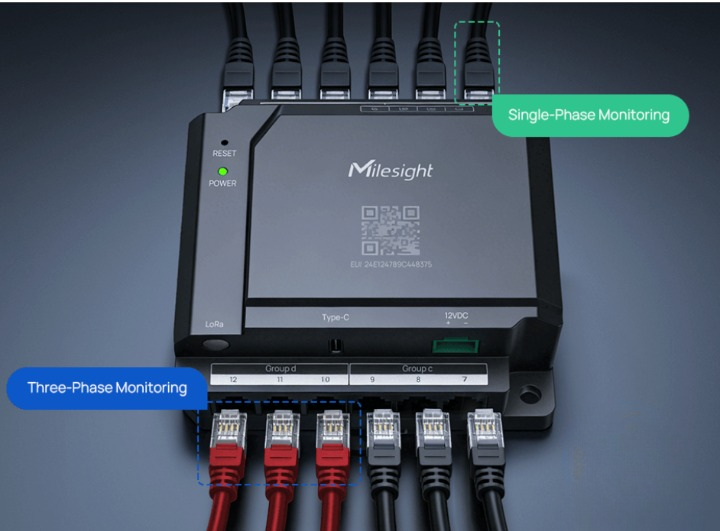
CTH01 monitors up to 4 three-phase circuits or 12 single-phase circuits from a single compact unit, transmitting data over LoRaWAN®. Instead of installing a separate meter per circuit, one hub covers an entire distribution board — cutting hardware cost, wiring complexity, and the footprint needed inside already-crowded electrical cabinets.
For ESG consultants building a measurement and verification (M&V) plan, that density matters: more circuits monitored per site visit means faster, more affordable coverage across a portfolio.
Effortless, Non-Invasive Installation
Traditional submetering projects are disruptive by nature — panels need to be de-energized, wires cut or stripped, and conduits opened. CTH01 is built specifically to avoid this:
- Magnetic voltage probes snap directly onto breaker screws — no terminal wiring or wire stripping required.
- Split-core current transformers (CTs) and Rogowski coils clamp around existing conductors without cutting cables or interrupting power.
- RJ11 push-click connectors let installers add current channels in seconds, without tools or risk of wiring errors.
- DIN rail or magnetic mounting fits standard electrical cabinets without custom brackets.
The practical result: zero downtime during installation, a shorter site visit, and a lower dependency on specialist electrical contractors — a meaningful cost lever when a building owner is rolling this out across many boards or an entire portfolio.
Industrial-Grade Accuracy You Can Trust for ESG Reporting
Data that will end up in a sustainability report or a tenant invoice has to hold up to scrutiny. CTH01 is built to a standard that supports that:
- Class 1 accuracy for active energy (±1%), certified to IEC 62053-21; reactive energy accuracy is ±2% per IEC 62053-23.
- 8 kHz high-speed sampling, which captures not just consumption but grid health indicators: voltage total harmonic distortion (THDv), current total harmonic distortion (THDi), voltage unbalance across phases, and power factor.
- Support for current ranges up to 4,000A (customizable), covering everything from small tenant circuits to main incomers.
That combination — certified accuracy plus harmonic and power-quality diagnostics — is what turns a simple energy log into data that can support both cost-allocation billing and equipment health monitoring, without adding separate power-quality analyzers to the budget.
Simple to Check, Simple to Get the Data
A sensor is only useful if facilities staff can actually check it and pull data without friction. CTH01 is designed around that:
- Bluetooth configuration via the Milesight Toolbox App — technicians can commission the device and verify readings from a safe distance, without opening the panel again.
- Remote CT-direction calibration in software — a wrong-polarity CT no longer means a truck roll; it’s fixed with a setting.
- LED status indicator for at-a-glance health and alarm status during walkthroughs.
- On-device data storage of up to 20,000 data entries and 2,000 alarm events, plus 12 months of energy statistics, so historical data survives even if connectivity is briefly interrupted.
- Configurable threshold, out-of-range, and power-failure alarms, so anomalies surface automatically instead of waiting for a manual review.
For a building engineer managing dozens of hubs, or an ESG consultant auditing several sites, this removes the need for manual meter reads or on-site data pulls entirely.
Seamless Integration with BMS and Cloud Platforms
Energy data only creates value once it reaches the systems people actually use — a BMS dashboard, an energy management platform, or an ESG reporting tool. CTH01 is built to plug into that stack rather than sit beside it:
- LoRaWAN® connectivity (OTAA/ABP, Class C) across CN470/EU868/US915/AS923 and other regional bands, working with any standard LoRaWAN gateway.
- Milesight IoT Cloud and DeviceHub for out-of-the-box dashboards, bulk device management, and over-the-air updates across a whole portfolio.
- Open API and webhooks, allowing energy data to flow directly into third-party BMS, EMS, or ESG reporting platforms.
- Compatibility with the Milesight BACnet driver / building IoT gateway, giving facilities teams a standards-based path to expose CTH01 data as BACnet points inside an existing BMS — no rip-and-replace of the building’s control system required.
For building owners already running a BMS, this means CTH01 data becomes just another set of points on the same dashboard operators already use — not a separate silo to check.
Where This Fits: Building Owners and ESG Consultants
Energy monitoring and savings. Granular, circuit-level visibility exposes “dark” energy waste — equipment left running after hours, idle loads, inefficient scheduling — that whole-building meters simply can’t see.
Commercial cost allocation. Property and facilities managers in offices, retail portfolios, and co-working spaces can use CTH01’s real voltage monitoring for transparent, defensible tenant billing, without the data gaps that come from estimating usage off a single main meter.
Predictive maintenance. Harmonic distortion and voltage unbalance are early warning signs of failing equipment. Captured at 8kHz, these signatures let facilities teams intervene before a motor or transformer actually fails.
Solar and distributed energy. For buildings with rooftop solar, CTH01 separately tracks imported and exported power, helping owners maximize self-consumption and accurately track feed-in performance — directly relevant to Scope 2 emissions reporting and renewable-energy claims in an ESG report.
CTH01 Specifications at a Glance
| Category | Detail |
| Channels | Up to 4 three-phase or 12 single-phase circuits |
| Accuracy | Active energy ±1% (IEC 62053-21, Class 1); Reactive energy ±2% (IEC 62053-23) |
| Sampling | 6–8 kHz |
| Current range | Up to 4,000A (customizable) |
| Voltage range | 100–500V AC |
| Connectivity | LoRaWAN® (OTAA/ABP, Class C); regional bands incl. EU868/US915/AS923/CN470 |
| Configuration | Bluetooth via Milesight Toolbox App |
| Data storage | 20,000 entries, 2,000 alarms, 12 months of statistics |
| Mounting | DIN 35 rail or magnetic (optional) |
| Ingress protection | IP30 |
| Operating temperature | -20°C to 70°C |
| Certifications | ETL (UL/CSA 61010), CE (RED & LVD), FCC, SRRC, RoHS |
Why Building Owners and ESG Consultants Choose CTH01
Between the installation savings, certified accuracy, and native path into a BMS or cloud dashboard, CTH01 addresses the three things that usually stall a building energy-monitoring rollout: cost of install, trust in the data, and effort to actually use it. That makes it a practical fit not just for a single energy audit, but as a permanent, low-maintenance layer of energy visibility across a building or portfolio.
Ready to bring circuit-level, ESG-grade energy data into your building? Get in touch with NexAscent to scope a CTH01 deployment for your site — from board-level installation planning through BMS and dashboard integration.