Milesight People Counter Comparison: 7 Milesight sensors compared
Which Milesight People Counter Fits Your Entrance? A Technical Selection Guide for Building Owners
Start With the Physical Constraint, Not the Feature List
This Milesight people counter comparison exists because the single biggest cause of underperforming people-counting deployments isn’t the sensor — it’s a mismatch between the sensor’s optical range and the physical opening it’s mounted over. A sensor rated for a 2.5m storefront ceiling will lose accuracy fast at 6m, and a high-mount unit designed for atriums is over-specified (and over-priced) for a single boutique doorway.
This guide sorts Milesight’s people-counting lineup by the three variables that actually determine fit: mounting height, coverage width, and site conditions (indoor/outdoor, power and network availability). Match your entrance to a row below before comparing feature lists.
Milesight People Counter Comparison Table: Height, Coverage, IP Rating & Connectivity
Installation height figures below are pulled directly from each model’s official user guide, not marketing copy — the two don’t always agree, and the user guide is the version installers actually work from.
| Model | Installation Height (per user guide) | Coverage / Field of View | IP Rating | Connectivity | Multi-Device Stitching |
| VS133 | Max 3.5m. Minimum height = pedestrian height + 0.5m + 0.035m (e.g. ~2.34m for a 1.8m-tall pedestrian) | 98° H / 80° V FoV, 0.5–3.5m detection range | IP40 (indoor) | PoE (802.3at PoE+) | Up to 4 devices |
| VS135 — Standard | Max 3.5m. Same minimum-height formula as VS133 (~2.3m for 1.8m pedestrians) | 98°H/80°V | IP40 (indoor) | PoE+, 4G Cellular, or LoRaWAN® — model-dependent | Up to 8 devices |
| VS135 — High Ceiling Mount | Max 6.5m. Minimum height = pedestrian height + 2m + 0.035m (e.g. ~3.84m for a 1.8m-tall pedestrian) | 60°H/45°V, 22.05m² coverage at max height | IP40 (indoor) | PoE+, 4G Cellular, or LoRaWAN® — model-dependent | Up to 8 devices |
| VS125 | 2.2m – 6m | 101° H / 70° V FoV; ~10.4 × 6.0m coverage at 6m height | IP40 (indoor) | PoE (802.3af) or 4G Cellular | Up to 16 devices |
| VS125-LW | 1.9m – 3.5m (low-ceiling optimized) | 130° H / 117° V FoV; up to ~40m² coverage at 3.5m height | IP40 (indoor) | PoE (802.3af) or 4G Cellular | Up to 16 devices |
| VS125-Outdoor | 2.2m – 6m (same range as indoor VS125) | 101° H / 70° V FoV, same optics as VS125 | IP67 (outdoor), -30°C to 65°C operating range | PoE or 4G Cellular | Up to 16 devices |
| VS126 | 6m – 15m (ultra-high mount) | 75.4°H/57.4°V max FoV; 75m²+ coverage at height | IP40 (indoor) | PoE (802.3af) or 4G Cellular | Up to 16 devices |
Notes on the ToF minimum-height formula (VS133, VS135): these sensors calculate minimum mounting height as maximum pedestrian height + a fixed offset + a 0.035m measurement-error margin. In practice this means the effective usable range is narrower than the headline max figure suggests — always calculate the minimum for your tallest expected visitor before finalizing a mounting height near the low end of the range.
Reading the table for your site:
- Installation height determines which models are physically viable — this is the non-negotiable filter, and the reason to check the user guide (not just the datasheet or product page) before ordering.
- Coverage/FoV determines how many sensors you need to fully cover a wide entrance or atrium floor.
- IP rating determines whether the unit can be mounted in a covered outdoor walkway, canopy entrance, or semi-exposed loading area — only the VS125-Outdoor is rated for genuine outdoor exposure (IP67); the rest are IP40 and belong strictly indoors or under full weather protection.
- Connectivity determines installation cost and speed — PoE needs a single Cat5e/6 run per device, while 4G Cellular and LoRaWAN® variants avoid data cabling entirely (useful for heritage buildings, glass atriums, or retrofits where running cable is disruptive or expensive).
What Multi-Device Stitching Actually Does
Multi-device stitching is easy to skim past in a spec sheet, but it’s the mechanism that decides how many sensors a wide entrance actually needs.
A single sensor’s coverage is fixed by its field of view and mounting height (see the table above). When an opening is wider than one unit can cover — a six-lane mall entrance, a supermarket frontage, an atrium floor — Milesight sensors can be linked so their individual detection zones merge into one continuous counting area, rather than operating as separate, uncoordinated devices.
Why this matters in practice:
- Prevents double-counting at the seams. Without stitching, two adjacent sensors would each count a shopper crossing near the boundary between their zones, inflating the total. Stitched devices share tracking data so a person is counted once as they cross the combined area, even while transitioning from one sensor’s field of view into the next.
- Coverage scales without losing accuracy. Milesight’s stereo-vision models (VS125/VS125-LW/VS125-Outdoor/VS126) support up to 16 devices stitched together; the ToF models (VS133/VS135) support 4 and 8 respectively. Stitching is configured through automatic deflection-angle detection during setup — installers don’t need to manually calibrate overlap zones on site.
- One data feed instead of many. Stitched sensors report as a single logical entrance in the dashboard, which matters for reporting — a marketing team wants one footfall number for “Main Entrance,” not four separate device feeds to reconcile manually.
Sizing rule of thumb: divide your entrance’s total walkable width by the single-unit coverage width at your mounting height (from the comparison table), round up, and confirm against Milesight’s coverage calculator tool before finalizing quantities — detection zones need to be tangent or slightly overlapping, not just adjacent, for stitching to work correctly.
Matching Sensor to Environment: Six Common Scenarios
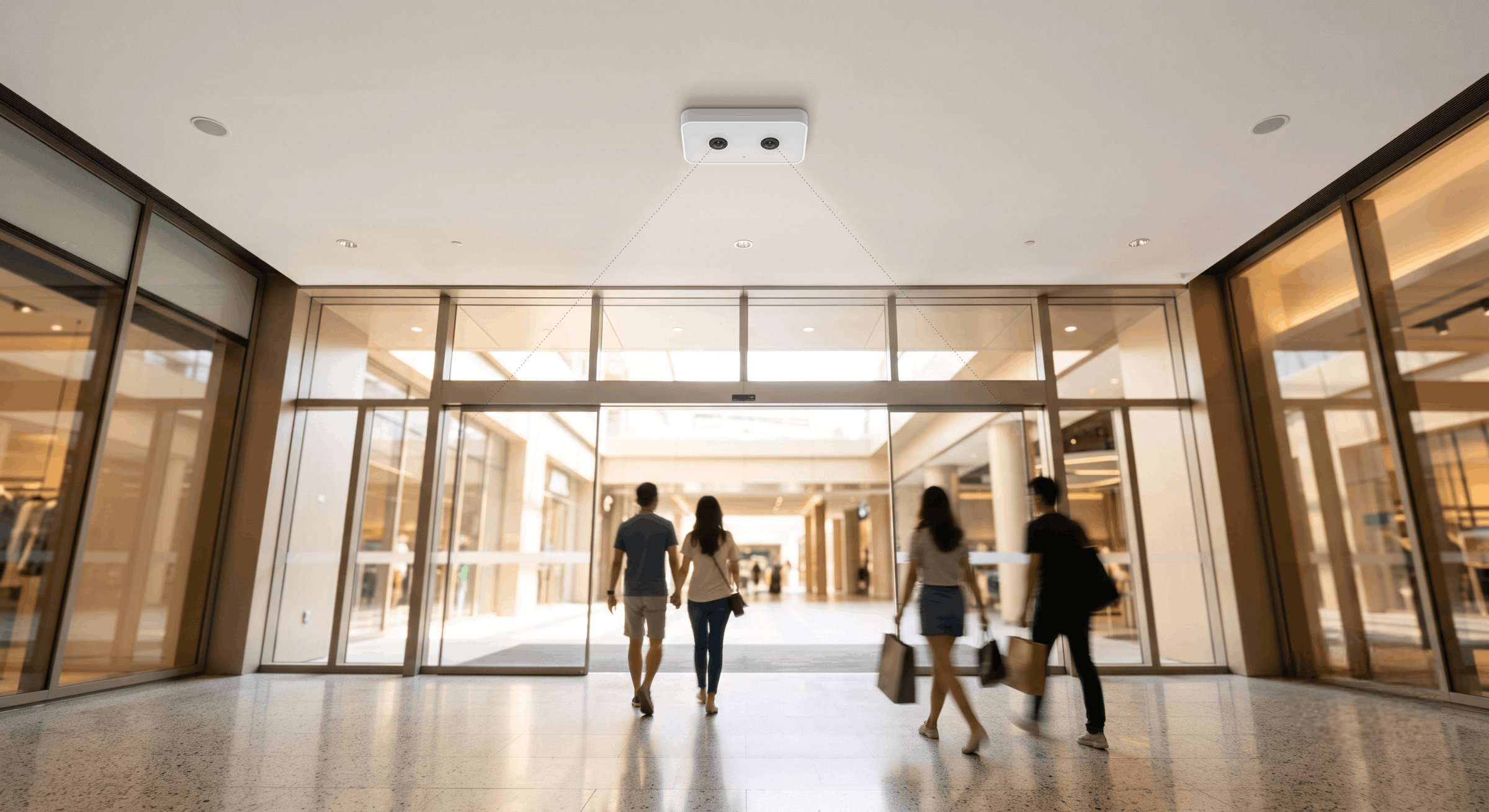
- Standard mall or retail entrance, 2.2m–6m ceiling, indoor → VS125. This is the default choice for most mall storefronts, department store entrances, and building lobbies — 16-device stitching covers wide multi-door frontages, and PoE keeps installation simple.
- Boutique store or narrow doorway under 3.5m → VS133 or VS125-LW. VS133 is the cost-efficient ToF option for straightforward bi-directional counting; VS125-LW adds gender recognition, staff detection, and heat maps if the marketing team wants shopper profiling from a low ceiling.
- Wide supermarket entrance or high-traffic corridor with trolleys/carts → VS135. Its shopping cart fill-level detection and tailgating detection are purpose-built for this scenario, and 8-device stitching handles unusually wide openings. Confirm whether your ceiling calls for the Standard (up to 3.5m) or High Ceiling Mount (up to 6.5m) version — they’re ordered as different variants, not a field-adjustable setting.
- Mall atrium, airport concourse, or high-ceiling common area (6m–15m) → VS126. This is the only model in the range engineered for true high-mount installation — standard sensors lose accuracy well before 6m.
- Covered outdoor walkway, canopy entrance, or semi-exposed loading bay → VS125-Outdoor. IP67 and a -30°C to 65°C operating range are essential here; deploying an IP40 indoor unit outdoors will void reliability and likely the warranty.
- Heritage building, glass frontage, or any site where running network cable is impractical → VS135 (LoRaWAN® or 4G variant) or VS125/VS126 (4G Cellular variant). These skip the Ethernet run entirely, which materially reduces installation cost and disruption in retrofit projects.
Why Building Owners and Marketing Teams Are Standardizing on Milesight People Counter
- Newest-generation sensing technology. The VS13x series runs 2nd-generation Time-of-Flight sensing, while the VS125/VS126 series uses AI-enhanced binocular stereo vision with 0-lux infrared illumination — meaning full accuracy in complete darkness, not just daylight hours. Both approaches are current-generation technology, not the older single-camera or PIR-based counters still common in the market (which top out around 80–90% accuracy for multi-person scenes).
- Reasonable cost relative to accuracy delivered. All models in this range are independently rated up to 99.8% accuracy — a figure typically associated with premium stereo-vision systems costing significantly more per door. The tiered lineup (ToF sensors for straightforward counting, stereo-vision sensors for demographic/behavioral analytics) means you’re not paying for features you don’t need at a boutique entrance, while still having a clear upgrade path to VS125/VS126 for flagship locations.
- Easy-to-use dashboard and centralized management. Cloud based webportal with dashboard from our partners provide plug-and-play device setup, bulk configuration across sites, over-the-air firmware updates, and an open API/webhook layer for pushing data into your own BI tools or BMS. For a marketing or facilities team without a dedicated data engineer, this matters as much as sensor accuracy — a technically excellent sensor is only useful if the people who need the data can actually get to it without a systems integrator on standby.
- GDPR-compliant, privacy-first by design. All models anonymize detection data at the edge, which simplifies compliance conversations with tenants and legal teams — increasingly relevant as more jurisdictions scrutinize in-mall tracking technology.
BACnet & BMS Integration: What’s Actually Supported
For facilities teams, footfall data is most useful when it lands inside the same Building Management System (BMS) already running HVAC, lighting, and access control — not as a separate silo requiring a second login.
What’s confirmed natively: The PoE/Ethernet variants of the ToF and stereo-vision sensors — specifically VS133-P and the VS125-P family (VS125, VS125-LW PoE versions) — list BACnet/IP directly among their supported network protocols, alongside HTTP(S) and MQTT(S). This means these units can register as BACnet objects on your building network without an intermediate gateway, which is the simplest integration path if your BMS is BACnet-native (as most commercial building systems are).
What requires a gateway: The 4G Cellular and LoRaWAN® variants do not carry BACnet/IP natively over their radio connection — their published protocol lists show HTTP(S)/MQTT(S) only, and the sensor itself has no BACnet stack. For LoRaWAN® sensors specifically, BACnet support lives in the gateway, not the sensor: the LoRaWAN gateway (or a network server such as ChirpStack sitting behind it) receives the sensor’s data and exposes it to the BMS as BACnet/IP, Modbus, or MQTT. In practice this means the BACnet capability of a LoRaWAN deployment is a property of the gateway you select, not something to look for on the VS135 datasheet — confirm the gateway/network-server model supports BACnet output before specifying a LoRaWAN people-counter rollout for a BACnet-integrated site. 4G Cellular variants follow a similar pattern via a cloud platform or controller rather than a local gateway.
Practical implication for site design: if BACnet-to-BMS integration is a hard requirement (common in Class-A office towers and large malls with centralized BMS oversight), lead with the PoE variants (VS133-P, VS125-P) for entrances where that matters. Where a LoRaWAN® deployment is preferred instead — for example, across a multi-entrance retrofit where running Ethernet is impractical — BACnet integration is still achievable, but it depends on pairing the sensors with a BACnet-capable gateway; this shifts the integration decision from “which sensor SKU” to “which gateway,” and that gateway choice should be locked down before the sensor order goes in.
Practical Next Step
Before finalizing your Milesight people counter comparison shortlist, measure actual ceiling height at each entrance and note whether the location is climate-controlled or exposed to weather — these two data points alone will eliminate most of the wrong-fit options above. For mixed portfolios (retail entrances + an atrium + an outdoor colonnade), it’s common to deploy 2–3 different VS-series models across a single site rather than standardizing on one, since the height and exposure profile genuinely differs by location.
Contact NexAscent for a discussion and a trial to confirm that the Milesight people counters works for you.