Real-Time Floor Occupancy Monitoring with People Counting Sensors and BMS Integration
Real-Time Floor Occupancy Monitoring: How a Few Sensors Feed Live Headcount to Your BMS
People counting sensor BMS integration is now the most practical way to achieve real-time floor occupancy monitoring in commercial buildings — and it requires far less infrastructure than most building owners expect.
Access control logs record who badged in — not who is still present. CCTV requires manual review and cannot produce a number automatically. Scheduled headcounts are snapshots, not live data. For facilities managers and security teams responsible for floor-level oversight, an outdated figure is often operationally worse than no figure at all.
This article explains how a small number of strategically placed people counting sensors — specifically the Milesight VS125-P — can deliver a continuous, real-time floor headcount, integrated directly with a Building Management System (BMS), without additional network infrastructure or specialist IoT expertise.
This is the core promise of people counting sensor BMS integration — actionable occupancy data, delivered continuously, with no additional operational overhead.
The Core Principle: Count Every Boundary, Not Every Desk
Effective floor-level occupancy monitoring does not require tracking individuals across an open-plan space. It requires counting every entry and exit point that connects the floor to the rest of the building.
In a typical commercial office floor, three boundary types account for all movement:
- The lift lobby entrance — often a wide, open passage connecting the lift core to the office floor
- Access-controlled internal doors — separating the lobby area from the main office interior
- The emergency staircase exit — a mandatory egress point that must be monitored independently
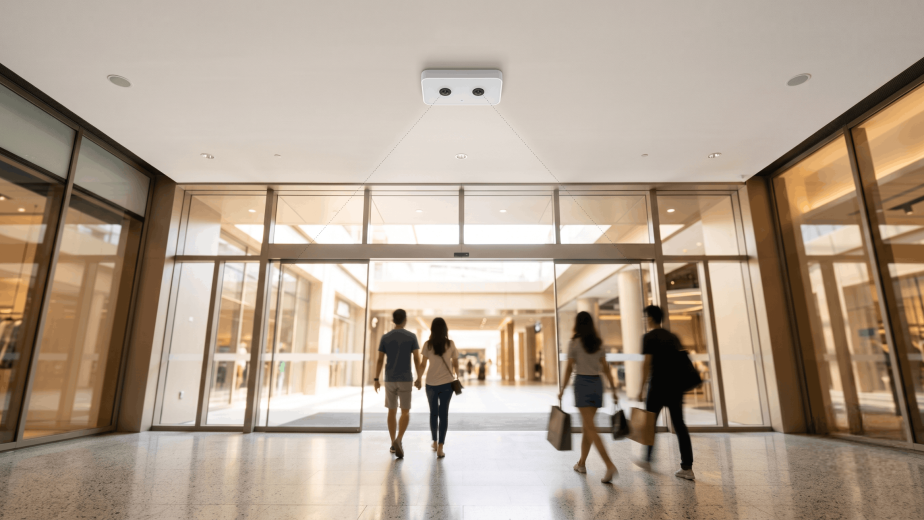
A VS125-P sensor mounted at each of these points counts individuals entering and exiting, with direction determined by the sensor’s dual-lens stereo depth vision. The occupancy calculation is straightforward:
Live headcount = Total entries − Total exits
This perimeter-based approach achieves complete floor coverage with a minimal sensor count — making it cost-effective to deploy and straightforward to maintain.
For building operators evaluating people counting sensor BMS integration, this boundary-based method is the most infrastructure-efficient approach available.
Why the VS125-P Is the Right People Counting Sensor BMS Integration Choice
The VS125-P is the Power over Ethernet (PoE) variant of Milesight’s VS125 people counting sensor, and this distinction matters significantly for BMS integration scenarios.
Single-cable deployment. PoE delivers both power and data over one standard Ethernet cable. No dedicated power circuit, no battery management, no additional conduit runs — only a network drop at each mounting location is required.
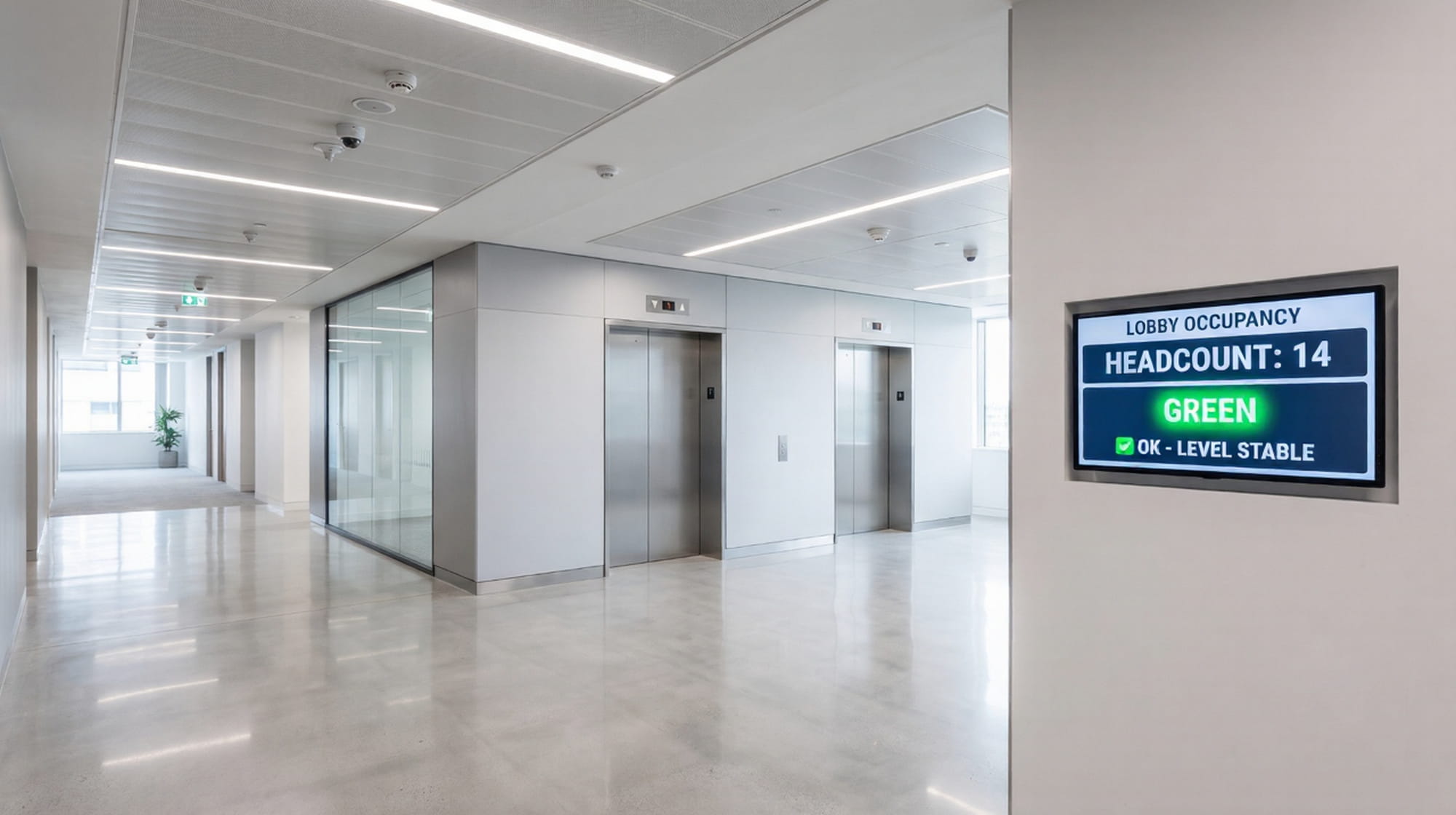
Real-time data transmission. The sensor pushes occupancy data continuously over the local IP network. The BMS receives a live feed and can display an up-to-the-second floor headcount on the building management dashboard. There is no polling delay, no batch update cycle, and no middleware layer required between sensor and BMS.
Wide-entrance accuracy. The VS125-P uses overhead stereo depth vision rather than PIR or single-lens imaging. This makes it suitable for lift lobby entrances that may span three to four metres — environments where PIR-based solutions consistently degrade in accuracy.
Privacy by design. The sensor processes depth data, not video. No identifiable images are captured or stored, making deployment straightforward from a personal data protection standpoint.
Operational Value by Stakeholder
Building Owners
A live, continuously updated floor headcount delivers measurable value across four dimensions:
- Emergency and fire response. At the moment of evacuation, the current occupancy figure — not the morning access log — determines how many people must be accounted for at the muster point. Real-time data directly supports warden accountability and emergency services coordination.
- Security and tailgating detection. Access card systems can be bypassed by tailgating. A people counter cannot be bypassed — every person who crosses the sensor threshold is counted, regardless of badge status. A non-zero count on a floor that should be empty after hours is an immediate, automatic alert.
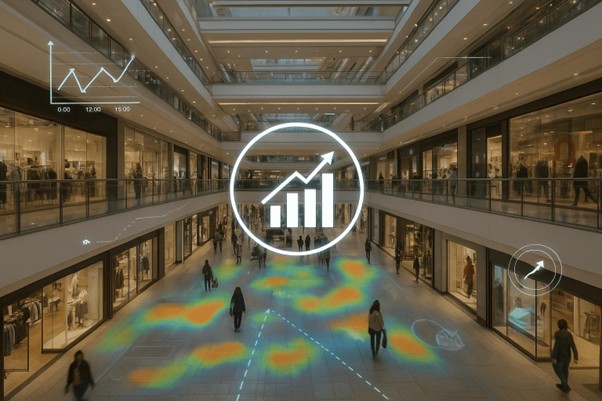
- Space utilisation and lease planning. Time-stamped occupancy records reveal actual usage patterns across the working day and week. This data informs cleaning schedules, HVAC zoning, and decisions about floor area requirements at lease renewal.
- Compliance and liability. In regulated environments or buildings with maximum occupancy limits, a verifiable data trail demonstrating compliance has tangible insurance and legal value.
BMS Integrators
The VS125-P is purpose-built for people counting sensor BMS integration — it connects to standard BMS platforms over IP without proprietary middleware.
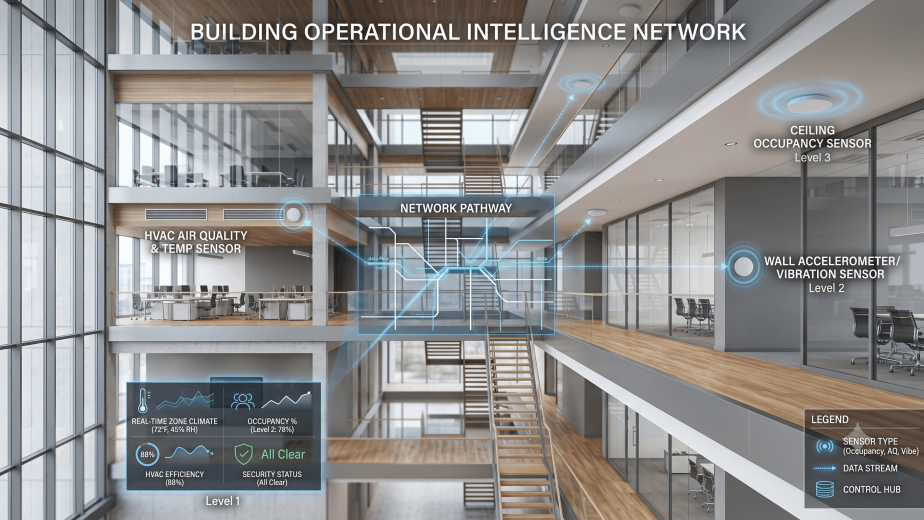
This live variable can drive automated building responses directly from the BMS:
- HVAC setpoint and airflow adjustments scaled to actual occupancy
- Lighting zone activation and deactivation based on floor presence
- Alert thresholds that trigger notifications when occupancy exceeds limits or fails to reach zero at expected times
Commissioning is straightforward: ceiling mount, network drop, PoE switch port. The sensor behaves like any standard networked device and requires no specialist IoT hardware knowledge to install or replace.
Facilities Management and Security Teams
For FM teams, the occupancy figure integrates into the BMS dashboard that is already in daily use. There is no new interface, no additional workflow, and no manual aggregation step. The number is simply present, continuously updated.
For security personnel, the value accumulates over time. Patterns that would require retrospective CCTV review become immediately visible: a count that does not return to zero at end of business, an after-hours spike on a floor that should be empty, or an occupancy figure that does not align with expected shift patterns. A people counting system does not replace access control or CCTV — it adds the quantitative dimension that neither system provides independently.
Frequently Asked Questions
Can the VS125-P handle wide lift lobby entrances? Yes. The sensor’s stereo depth vision covers wide entrance spans accurately, including typical lift lobby openings of three to four metres, where PIR and single-camera solutions lose accuracy.
Does it require a separate IoT platform or cloud subscription? No. The VS125-P transmits over PoE directly to the local network. BMS integration uses standard IP protocols — no cloud dependency, no ongoing SaaS subscription required for the core counting function.
Is the system privacy-compliant? The sensor captures depth data, not video or images. No personally identifiable information is processed or stored, which simplifies compliance with Singapore’s PDPA and comparable data protection frameworks.
How many sensors does a typical floor require? This depends on the number of boundary points. A floor with one lift lobby entrance, one internal door zone, and one emergency exit requires a minimum of three sensors — one per boundary type. Additional sensors are added only where multiple parallel access points exist at the same boundary.
Summary
People counting sensor BMS integration is a solved problem — the technology is mature, infrastructure requirements are minimal, and BMS integration is a standard deployment pattern for PoE-based sensors.
The Milesight VS125-P, positioned at lift lobby entrances, internal access doors, and emergency staircase exits, delivers a live floor headcount to the BMS continuously — giving building owners, integrators, FM teams, and security personnel a single, reliable number they can act on in real time.
NexAscent deploys people counting and occupancy monitoring solutions for commercial buildings, facilities managers, and BMS integrators across Singapore and the region. Contact us to discuss a floor occupancy deployment for your building.