LoRaWAN Smart Buildings: 7 Proven Benefits for Rapid Adoption
What Is LoRaWAN?
LoRaWAN smart buildings are emerging as one of the fastest-growing categories in commercial IoT, but most building professionals are still more familiar with Wi-Fi and Bluetooth — wireless technologies designed for high-speed data transfer over short distances. LoRaWAN operates on an entirely different logic: it is built for low data, long distances, and minimal power.
LoRaWAN stands for “Long Range Wide Area Network.” It combines a physical radio technology called LoRa with a network protocol layer to create a communication standard specifically designed for Internet of Things (IoT) applications. In practice, this means a network of small wireless sensors — monitoring temperature, occupancy, energy, air quality, water flow, and more — can transmit data reliably across an entire building complex, or even across multiple sites, using very little power and minimal infrastructure.
LoRaWAN operates on licence-free sub-gigahertz radio bands, and its transmissions are robust against disturbances, making them receivable across great distances. Since December 2021, LoRaWAN has been formally recognised as an ITU international standard for Low Power Wide Area Networking — giving it the credibility and interoperability assurance that enterprise deployments require.
How It Works: The Architecture in Brief
The protocol comprises several key components: end devices such as sensors and actuators; gateways, which relay data to the network server; and network servers, which process and manage the data. This architecture supports scalable and cost-effective deployment across diverse environments.
The practical implication: a single LoRaWAN gateway installed in a building can collect data from hundreds — even thousands — of sensors across multiple floors, basements, and car parks. No new cabling. No per-device SIM cards. No dependency on the building’s existing IT network.
Key Benefits for Buildings and Facilities
-
Deep Coverage Without Cabling
LoRaWAN provides wireless range and strong building penetration, allowing a single gateway to cover an entire business complex with associated premises. LoRaWAN supports a link budget of up to 150 dB, delivering coverage across four to six concrete floors in most buildings — a significant advantage over Wi-Fi, Zigbee, and BLE, which typically cover only one to two floors. LoRaWAN is resistant to interference, with sensitivity values reaching up to -137 dBm, allowing signals to penetrate multiple walls and reach basement levels.
-
Years of Battery Life, Minimal Maintenance
The low energy consumption of LoRaWAN sensors and actuators supports battery life lasting up to 15 years. This eliminates the operational overhead of frequent battery replacements and makes retroactive sensor deployment in occupied buildings practical and non-disruptive.
-
Cost-Effective Deployment and Scaling
Due to its long range and deep penetration, fewer gateways are required to establish a private network, reducing overall setup costs. When compared to wired sensor deployment, LoRaWAN sensors can be integrated at one-tenth to one-hundredth the cost of adding equivalent wired sensors.
-
Enterprise-Grade Security
The security of LoRaWAN is ensured through end-to-end encryption, authentication, and integrity checks, using the Advanced Encryption Standard (AES) with a 128-bit key length.
-
Supports Both Private and Public Networks
It is straightforward to deploy both public and private LoRaWAN networks using the same hardware and software. A building owner can operate a fully self-contained private LoRaWAN network on-premises, keeping data sovereignty in-house.
LoRaWAN and the Building Management System (BMS): A Natural Partnership
The Gap in Today’s BMS: How even modern LoRaWAN smart buildings can outpace systems that haven’t kept pace with new demands.
Building Management Systems have been the central control layer of facility operations for more than 30 years. Originally developed for HVAC control, they have expanded in scope — but have not always kept pace with the new demands of modern buildings.
Traditional BMS primarily control HVAC, lighting, and fire safety. They lack granularity — one sensor might represent an entire floor or zone. Modern use cases demand room-level, desk-level, and zone-level insights, such as CO₂ readings, occupancy, and humidity, which old wired sensors simply don’t provide. The reason is structural: running wires is expensive and disruptive, especially in occupied or retrofit buildings. As a result, BMS integrators only wire what is deemed “essential,” leaving systems with minimal or no sensors for occupancy, indoor air quality, predictive maintenance, or water leak detection.
How LoRaWAN Fills the Gaps — Without Replacing the BMS
This is precisely where LoRaWAN smart buildings infrastructure earns its keep — translating sensor data into BMS-native signals without disruptive wiring.
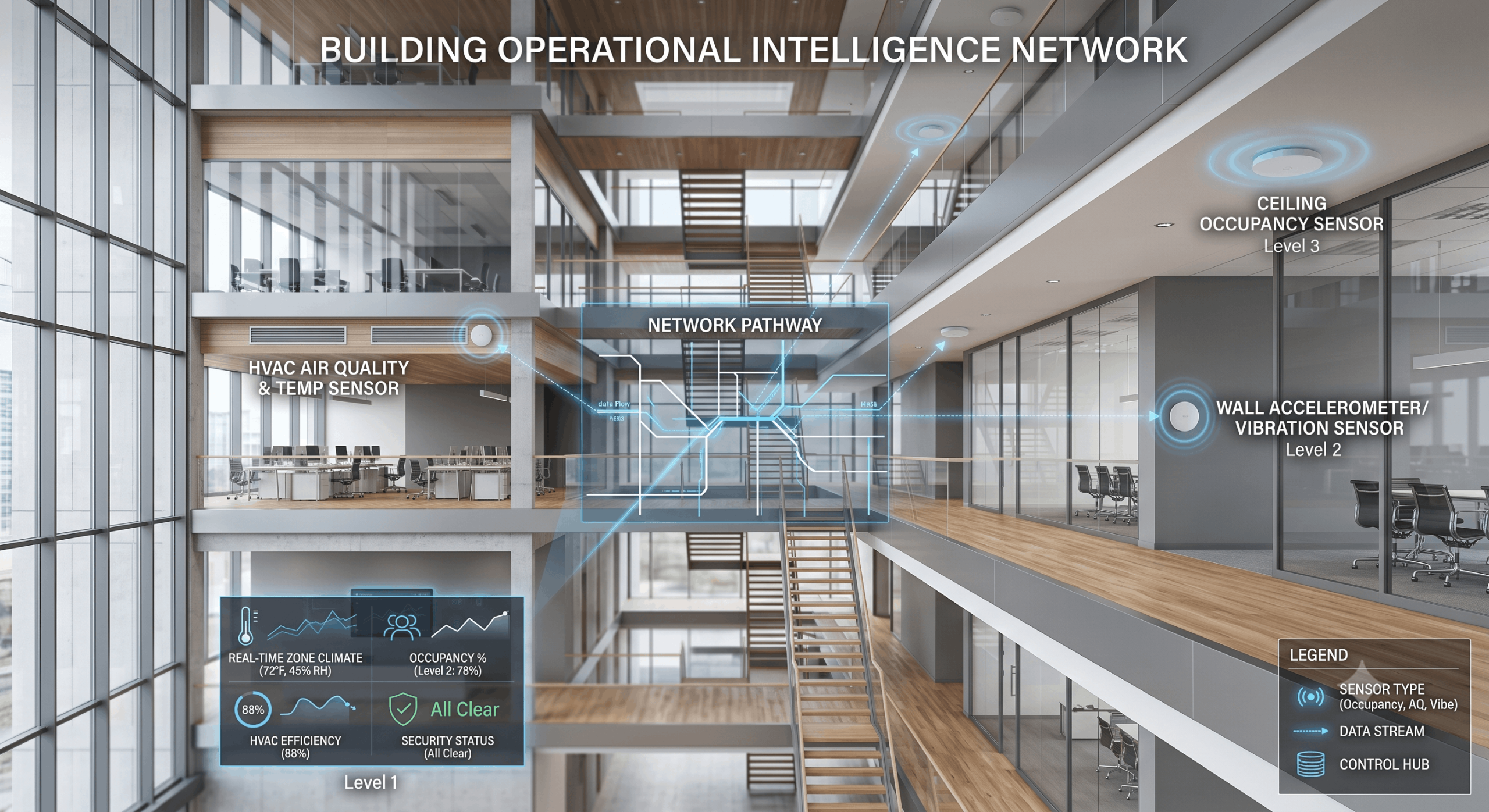
LoRaWAN BMS integration involves connecting a network of wireless, battery-powered LoRaWAN sensors to a central Building Management System. An integration gateway then translates this LoRaWAN data into a BMS-friendly protocol like BACnet or Modbus, enabling centralised control and automation without any disruptive wiring. This also allows for bidirectional control: instructions from the BMS can actuate a device — turning on or off a panel heater, adjusting the set point of a radiator, or switching off a water main after detecting a leak.
With the technology’s ability to integrate seamlessly into building management system standards like BACnet, KNX, Modbus, and similar environments, LoRaWAN enables a quick path to modernising and upgrading older facilities while retaining the value of existing building management systems.
By eliminating the need for conduit, cable trays, and labour-intensive wiring, projects can achieve up to 60% lower installation costs.
Smart Buildings: LoRaWAN’s Fastest-Growing Market
The Market Signal
The shift from pilot project to mainstream adoption is now well-evidenced. The LoRa Alliance announced in September 2025 that smart buildings have emerged as the fastest-growing vertical market for LoRaWAN deployments, with members reporting a double-digit increase in deployments over the past year.
Key applications driving a rapid return on investment for building owners include energy and operational efficiency, environmental monitoring, and preventive maintenance. Legislation, such as France’s BACS decree, which imposes a gradual reduction in energy consumption, is also accelerating activity in this sector.
In terms of overall market scale, research from Transforma Insights projects that LPWAN technologies such as LoRaWAN will collectively grow from 439 million connected nodes in 2024 to approaching 1.8 billion by 2034.
Why Adoption Has Accelerated
Several converging forces explain why LoRaWAN smart buildings have emerged as the leading growth vertical.
The technology has matured. LoRa’s Chirp Spread Spectrum physical layer delivers exceptional penetration through reinforced concrete walls and floors, enabling a single indoor gateway to cover an entire multi-story building while connecting hundreds or thousands of sensors running on coin cell batteries for five to ten or more years. Early adopters have proven the technology works reliably at scale in demanding building environments.
The regulatory environment is pushing action. The EU’s Energy Performance of Buildings Directive, which requires member states to accelerate building renovation and smart readiness, is driving significant investment in energy metering and monitoring. LoRaWAN’s ability to retrofit metering infrastructure into existing buildings without rewiring is a decisive advantage in this regulatory environment. Similar mandates are emerging across Asia and North America.
The economics have become undeniable. The retrofit economics of LoRaWAN are frequently underestimated. Unlike wired systems that require significant civil works, LoRaWAN sensors can be installed in minutes by a non-specialist, with no cabling, no conduit, and no disruption to building occupants. When sensors cost tens of dollars, run for years on a single battery, and can be deployed without a specialist contractor, the ROI calculation becomes straightforward.
The product ecosystem has reached critical mass. The range and quality of LoRaWAN-certified devices available to the market has grown dramatically. Manufacturers like Milesight have built comprehensive portfolios covering every major FM use case — IAQ, occupancy, energy, water, access, safety — with products that are not only technically capable but purpose-designed for commercial building environments. Milesight and Tridium have integrated Milesight’s advanced IoT sensing capabilities with Tridium’s Niagara Framework, simplifying system integration and reducing time spent on system configuration and deployment in smart building projects. In Dubai, a commercial building implemented Milesight’s LoRaWAN smart lighting control system and achieved a 25% reduction in lighting energy consumption within one month, saving approximately 11,000 hours of lighting use monthly.
This matters beyond feature lists. When products are intuitive to configure, aesthetically suited to professional environments, and cover a wide range of use cases in a single certified ecosystem, the decision to deploy becomes easier at every level — from the building owner evaluating ROI, to the FM manager specifying requirements, to the system integrator doing the installation.
LoRaWAN now speaks BMS natively. One of the most significant recent developments is the convergence of LoRaWAN with BACnet, the dominant open standard for building management systems. Native BACnet/IP support within LoRaWAN gateway infrastructure now enables LoRaWAN sensor data to appear as native BACnet objects within leading BMS platforms — without any middleware layer. This means facility managers and system integrators who have spent decades working in BACnet environments can now extend their existing infrastructure with LoRaWAN sensors without changing tools, workflows, or integrations.
LoRaWAN networks also co-exist easily with other wireless networks, being complementary to Wi-Fi, Bluetooth, 5G, and RFID — further enhancing their suitability for complex building environments.
Global Deployments: Where It Is Already Working
The proof is no longer theoretical. A selection of deployments from 2024–2025 illustrates the breadth of LoRaWAN’s smart building momentum:
Minew deployed hundreds of LoRaWAN sensors across major hospitals in Hong Kong via the government-led GWIN network, improving room occupancy visibility, cold storage compliance, and indoor air quality across hundreds of thousands of square metres.
A New York City high-rise condominium, deemed “uninsurable” after two major water events costing $6.6 million in total, installed 320 smart LoRaWAN water sensors through ProSentry. The sensors detected 31 leaks and caught a freezing door incident in real time before further damage could occur.
A youth hostel in Garmisch-Partenkirchen, Germany deployed LoRaWAN smart radiator thermostats across all 53 rooms, integrated with the existing BMS. Occupancy-based heating logic cut energy consumption per overnight stay by nearly 41% over two years, and reduced peak load from 172 kW to 65 kW — a retrofit completed during normal operations with device battery life of up to ten years.
Swisscom deployed a LoRaWAN service-on-demand solution for inspection rounds in facility management that reduced work times by 30% for Post Real Estate Management and Services.
Advantech deployed a LoRaWAN-based facility monitoring system across a major hospital in Taiwan, replacing manual inspection rounds with continuous wireless sensor coverage — vibration sensors on chillers, I/O modules on power meters, and gas distribution monitoring — feeding data to an on-premises edge server and private cloud without disrupting clinical wireless systems.
Applications in Smart Buildings and Facilities Management
As LoRaWAN smart buildings scale up, value compounds as more sensing layers are added to the same network infrastructure. The most impactful applications include:
Energy Monitoring and Sub-metering — Wireless sub-meters on electrical distribution boards, chillers, AHUs, and lighting circuits provide granular data without cabling works, enabling FM teams to identify inefficiencies and benchmark energy use by zone or tenant.
Indoor Air Quality (IAQ) — LoRaWAN-connected IAQ sensors monitoring temperature, humidity, CO₂, VOCs, and PM2.5 particulates feed directly into BMS and HVAC controllers, enabling demand-controlled ventilation. In a typical commercial office, this alone can reduce HVAC energy consumption by 20% to 40%.
Occupancy Analytics — Studies show that in most commercial offices, 40 to 60% of workstations and meeting rooms are vacant at any given time. LoRaWAN-connected people counters, desk occupancy sensors, and presence detectors provide granular, real-time data that powers hot-desking optimisation, predictive cleaning schedules, energy zoning, and dynamic space allocation.
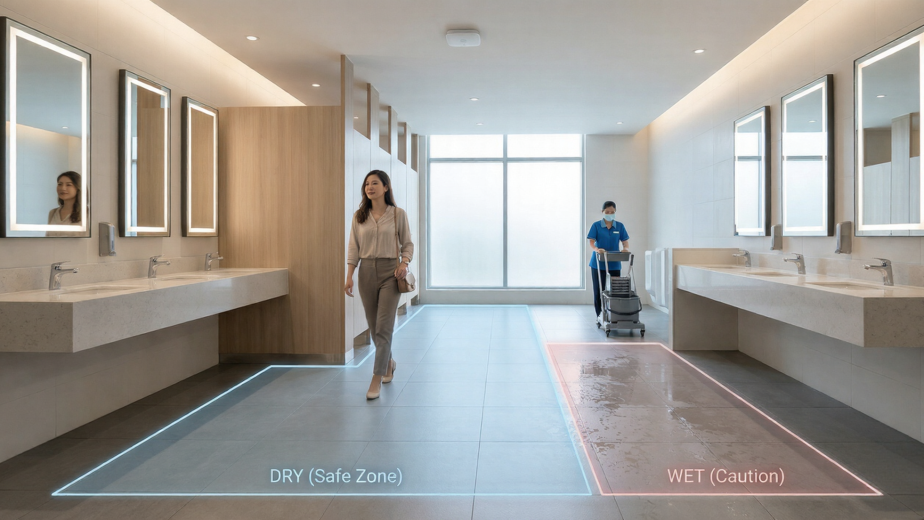
Washroom and Hygiene Management — Sensors monitoring toilet occupancy, consumable levels, and odour indicators allow cleaning to be deployed based on actual usage rather than fixed schedules.
Predictive Maintenance — Vibration, temperature, and current sensors on chillers, AHUs, pumps, and elevators enable condition-based monitoring that detects anomalies before they become failures — reducing both downtime and total maintenance cost.
Leak Detection and Water Management — LoRaWAN-connected water leak sensors installed at high-risk points — pipe joints, HVAC condensate trays, server room floors — provide continuous monitoring with multi-year battery life and instant alerts on detection.
Safety and Emergency Response — Wireless panic buttons, smoke detectors, and gas sensors connected over LoRaWAN provide a cost-effective safety layer, particularly for large or distributed properties where wired systems are impractical to extend.
LoRaWAN vs. Alternatives: Where It Fits
| Technology | Range | Power | BMS Integration | Best For |
| Wi-Fi | Short | High | Possible but complex | High-bandwidth data |
| Bluetooth/BLE | Very short | Medium | Rarely used | Short-range proximity |
| Zigbee / Z-Wave | Short–medium | Low | Limited | Home/SME automation |
| Cellular (4G/5G) | Wide | High | Possible, costly | Mobile assets |
| LoRaWAN | Long | Very Low | Native (BACnet/Modbus/MQTT) | Building-wide sensor networks |
For LoRaWAN smart buildings specifically, the technology stands out as the only wireless option that penetrates walls while maintaining low-power consumption — the unique combination that has driven its accelerating adoption in the smart building environment.
LoRaWAN is not suited for high-bandwidth applications such as CCTV or video analytics. Its strength lies precisely where FM operations generate the most value: frequent, lightweight sensor readings transmitted reliably at very low cost, visible within your existing BMS.
What This Means for Your Organisation
For owners and operators evaluating LoRaWAN smart buildings investments.
For building owners, LoRaWAN delivers measurable energy savings, supports sustainability certification, and protects asset value — all with a deployment model that does not require major capital works or tenant disruption.
For facilities managers, it closes the data gaps that wired BMS cannot reach economically, moves maintenance from reactive to preventive, and enables cleaning and operations to be driven by actual occupancy data.
For IT managers, it operates on dedicated, licence-free radio spectrum independent of corporate Wi-Fi, with AES-128 encryption built in and no dependency on the corporate network for sensor communications.
For innovation teams, LoRaWAN’s open standard, broad device ecosystem, and native BACnet/Modbus/MQTT compatibility provide a vendor-neutral foundation for smart building pilots with a credible path to enterprise scale.
The global smart building investment is projected to reach $570 billion by 2030, driven by energy efficiency mandates, ESG reporting requirements, tenant demand for healthy and productive environments, and AI-powered building analytics platforms that need real-time sensor data to deliver their value. LoRaWAN is exceptionally well-positioned to serve as the sensing backbone of this intelligent built environment.
Buildings that begin instrumenting their LoRaWAN smart buildings infrastructure today are building the operational intelligence that will differentiate them — in energy performance, tenant experience, and asset value — over the next decade. The window to establish that advantage ahead of regulatory deadlines and competitive pressure is now.
As LoRaWAN smart buildings move from pilot to mainstream, the operators who act early will set the benchmark others follow.
Is LoRaWAN suitable for smart buildings of any size? Yes — LoRaWAN smart buildings range from single-tenant offices to multi-tower campuses, with one gateway typically covering an entire mid-sized building. For larger portfolios, multiple LoRaWAN smart buildings can share network infrastructure for further cost efficiency.
NexAscent is a Singapore-based IoT and smart building technology company specialising in LoRaWAN-based sensor solutions for energy monitoring, facilities management, occupancy analytics, and predictive maintenance. For enquiries, visit us.