No Internet? No Problem: How Resorts Can Build a Complete Wireless Safety System Without the Cloud
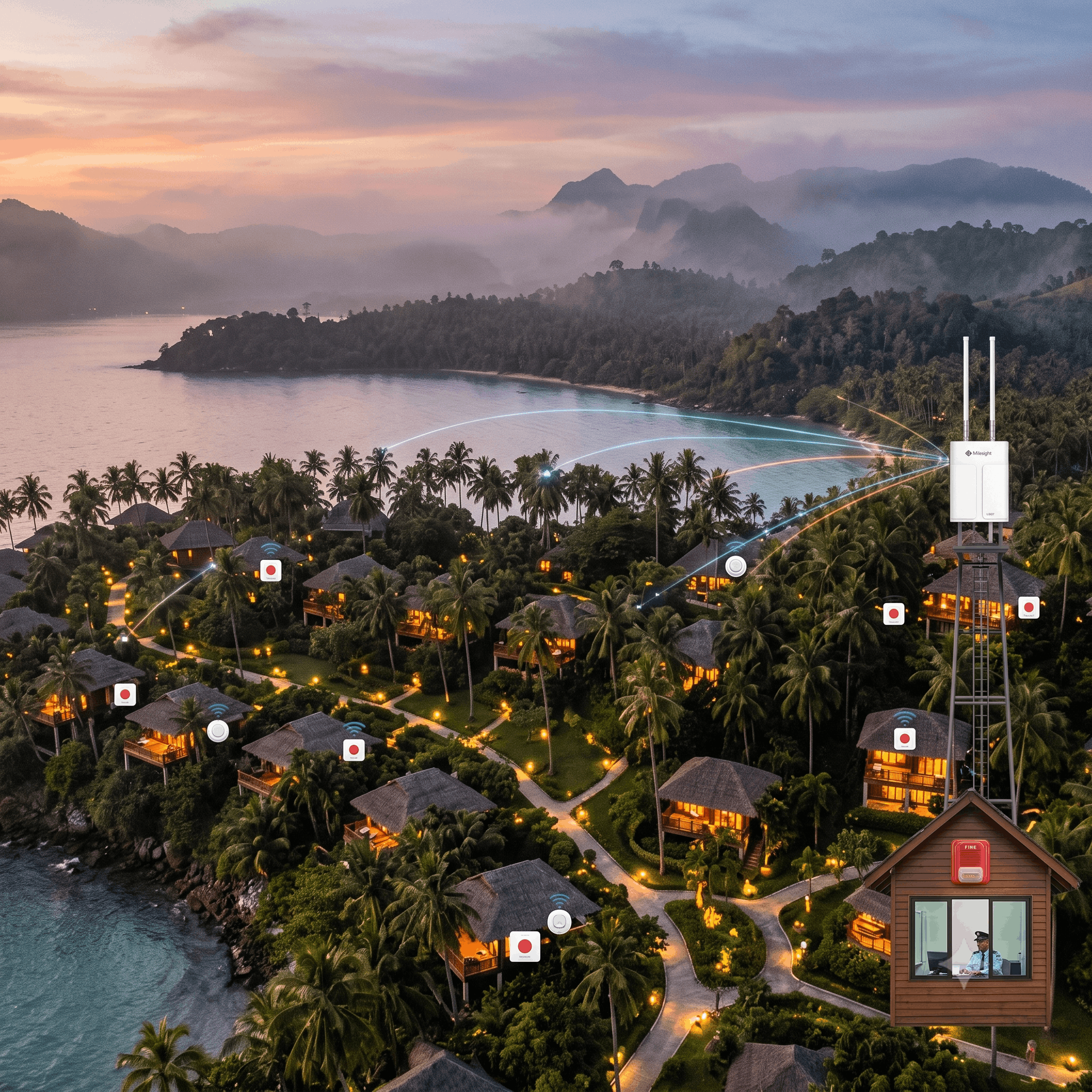
A wireless resort safety system is no longer a luxury — it is the most practical way to protect guests across remote villas without internet, 4G, or any wiring.
Resorts, eco-lodges, and villa clusters face a safety challenge that urban hotels rarely encounter: guests and staff are spread across a wide area — separated by gardens, pools, or jungle paths — with no practical way to wire everything together or depend on an internet connection that does not exist.
This is where LoRaWAN changes the equation entirely. With a self-contained, on-premises LoRaWAN network, resort operators can deploy a complete guest safety and fire detection system across up to 500 metres — with no SIM cards, no cloud dependency, and no trenching for cables.
Why LoRaWAN Is Built for Resorts
LoRaWAN (Long Range Wide Area Network) was designed for exactly this kind of environment: low-power sensors communicating reliably over long distances, indoors and outdoors, through walls and tropical vegetation.
- Range of 300–500m in resort environments — most villa clusters need only a single gateway
- Battery-powered sensors last 2–5 years — no wiring to any device
- Operates entirely on-premises — no internet connection required
- Immune to mobile network outages or congestion
- Scales easily — add new rooms or bungalows without changing infrastructure
- Weatherproof sensors available for tropical outdoor deployment
The Four Building Blocks of a Wireless Resort Safety System
A complete LoRaWAN safety solution for a resort is built from four types of devices, all communicating wirelessly back to a single gateway installed at your guard post or reception.
🆘 WS101 Smart Button — Guest Help Request
A single-press panic button for each villa or room. Guests press it to instantly alert security — no app, no phone, no Wi-Fi needed. Mount it beside the bed, near the entrance, or in the bathroom. Simple enough for any guest to use under stress.
🔥 LoRaWAN Smoke Detector — Fire Detection
A wireless smoke sensor for each bungalow. Ceiling-mounted and battery-powered, it triggers an alert the moment smoke is detected, day or night. No wiring to your fire panel, no manual inspection needed.
🚨 Siren & Strobe Light — Audible and Visual Alert
Installed at each villa, the siren and strobe can be triggered automatically by the smoke detector or remotely by the security operator. The audible alarm alerts occupants; the strobe guides them toward exits and signals to neighbours that an event is in progress.
📡 UG67 LoRaWAN Gateway — The On-Premises Brain
Installed at your guard post or reception building, this single device receives all signals from every sensor across the property and runs Node-RED locally. No internet, no cloud subscription, no monthly fees.
How It Works: From Button Press to Response
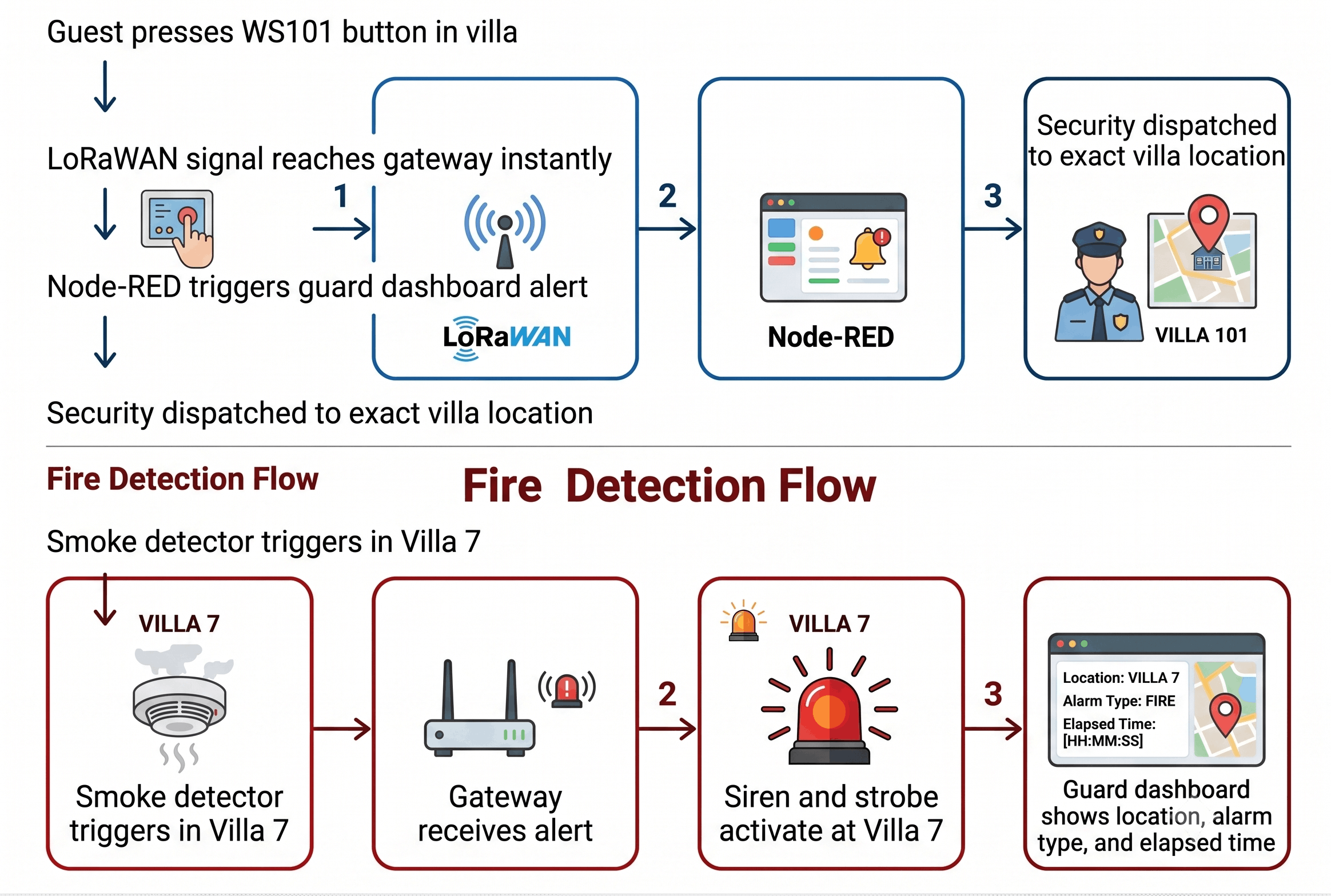
Guest Help Request Flow
The Guard Dashboard
The security guard at your reception or guard post sees a live dashboard — built locally on the gateway using Node-RED — showing the real-time status of every villa. Green means all clear. Any alert shows the villa number, the type of event (help request or smoke), and the time elapsed since the alert was raised.
No internet. No app to download. No cloud login.
What Makes This Different from a Traditional Alarm System
| Feature | Traditional Wired System | LoRaWAN On-Premises |
| Requires cabling to each villa | ✗ Yes — disruptive, expensive | ✓ No — fully wireless |
| Requires internet / 4G | ✗ Often yes | ✓ No — self-contained |
| Cloud subscription fees | ✗ Usually yes | ✓ None |
| Guest panic button included | ✗ Rarely | ✓ Yes — WS101 |
| Smoke + siren integration | ✗ Requires separate systems | ✓ Single unified system |
| Expandable without rewiring | ✗ No | ✓ Yes — add devices anytime |
| Sensor battery life | N/A | ✓ 2–5 years |
“The best safety system for a remote resort is one that works even when everything else fails — no internet, no power to the main building, no staff on-site. LoRaWAN makes that possible.”
A Typical Resort Deployment: 30 Villas
To give this concrete shape, here is what a deployment for a 30-villa resort looks like.
Per Villa
- 1× WS101 Smart Button (mounted near bed or at entrance)
- 1× LoRaWAN Smoke Detector (ceiling-mounted, battery powered)
- 1× Siren / Strobe Light (exterior-facing, weather-rated)
Central Infrastructure
- 1× UG67 LoRaWAN Gateway (installed at guard post or reception)
- 1× Siren / Strobe Light (exterior-facing, weather-rated)
- Node-RED guard dashboard running locally on the gateway
- PC with monitor at security desk for full-screen display
Coverage and Reliability
A single UG67 gateway covers a radius of approximately 500 metres in a typical resort environment —.sufficient for most boutique resort and villa cluster layouts — the core advantage of a wireless resort safety system that needs no cabling. For larger properties, a second gateway can extend coverage, with both feeding the same dashboard.
No wiring. No trenching. No cloud. The system is entirely self-contained. In the event of a power outage, a small UPS battery backup at the gateway keeps the safety network running independently of the main power supply.
What Resort Operators Should Plan For
Deploying a wireless resort safety system is straightforward, but a few practical considerations are worth addressing.
Site Survey First Dense concrete construction, metal roofing, or significant terrain variation can reduce effective range. A brief site survey before installation confirms gateway placement and whether a second unit is needed.
Staff Training Is Simple The guard dashboard requires no technical knowledge. Staff see a map or list of villas, with alerts highlighted clearly. Training typically takes under 30 minutes.
Maintenance Is Minimal Sensor batteries last two to five years depending on usage. The gateway requires a stable power supply and occasional firmware updates, which can be performed remotely via LAN or on-site.
Regulatory Compliance LoRaWAN devices operate on unlicensed spectrum (AS923 in Southeast Asia), meaning no frequency licences are required. Check local fire safety regulations regarding detector placement — the hardware is designed to support full compliance with standard requirements.
The Bottom Line for Resort Owners
Guest safety is not negotiable. But the systems built to deliver it were designed for hotels in cities, not resorts in the hills or by the sea.
LoRaWAN changes that. It is the first technology that makes a genuinely wireless, genuinely off-grid, genuinely wireless resort safety system practical for remote hospitality properties.
One gateway. A button, a smoke detector, and a siren for each villa. A dashboard your guard can act on in seconds. No internet required. No monthly cloud fees. No contractor drilling through your teak floors.
For resort operators who have accepted that “it’s just difficult out here” — it no longer has to be.
Ready to protect your property?
NexAscent designs and deploys LoRaWAN safety systems for resorts and villa clusters across Southeast Asia. We handle site survey, device supply, installation, and staff training.
Contact NexAscent to design your wireless resort safety system today.