IoT Panic Button System for Care Facilities: Smart Emergency Alerts That Save Lives
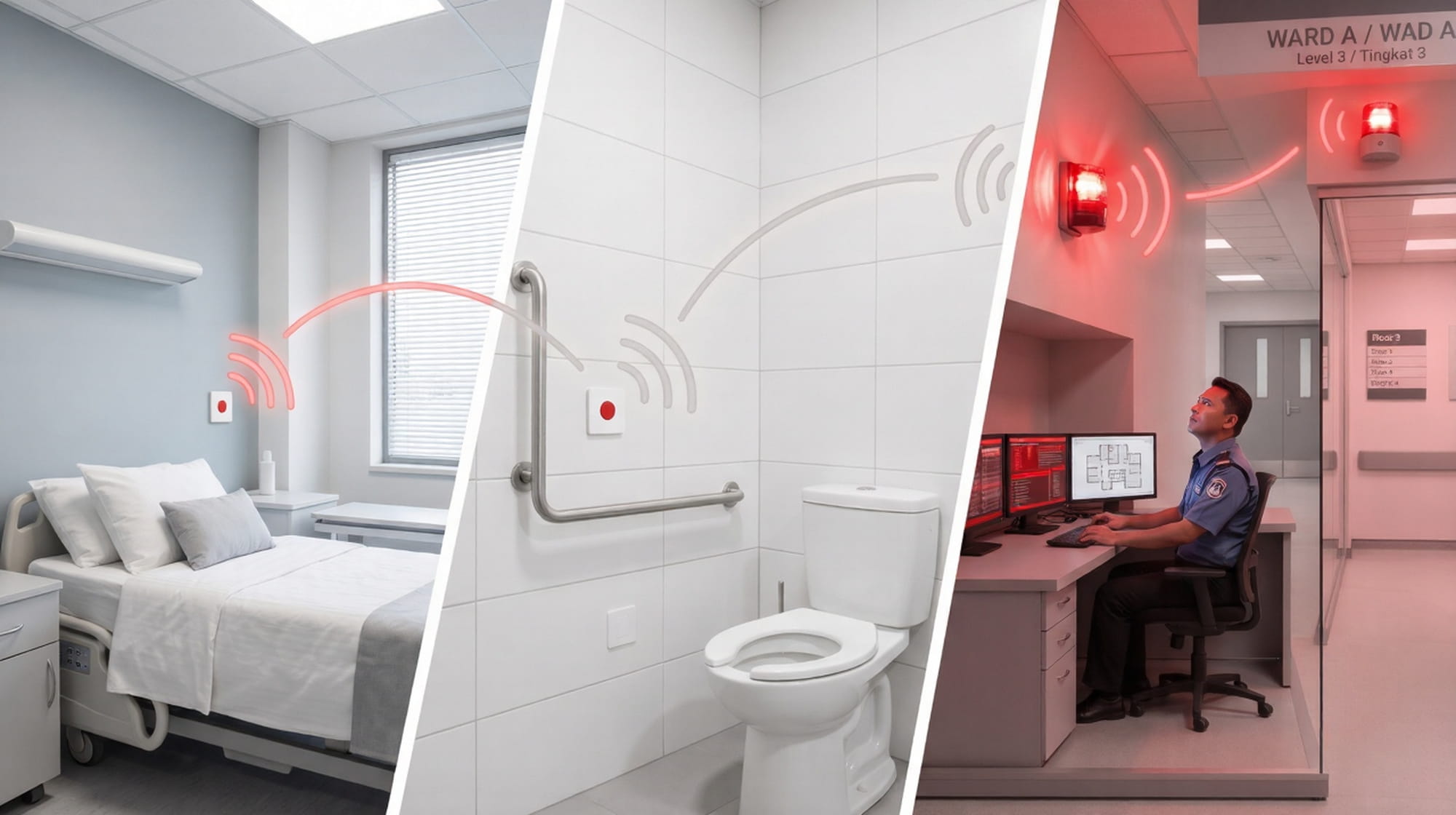
How a Smart IoT Panic Button System Is Transforming Emergency Response in Care Facilities
When seconds count, a delayed emergency response is not just an operational failure — it can be a matter of life and death. In healthcare environments, where vulnerable patients occupy private wards and staff may be stretched thin, the ability to summon immediate help with a single press of a button is not a luxury. It is a baseline safety requirement.
NexAscent’s IoT panic button system addresses this need with a modern, cloud-connected architecture that bridges wireless field devices, automated alerting, and centralised security response — all without requiring complex wired infrastructure.
The Challenge: Protecting Private and Semi-Private Patient Areas
Private hospital wards, VIP suites, and accessible (handicapped-accessible) washrooms share a common challenge: they are by design secluded. This privacy, which is essential for patient dignity and recovery, creates a blind spot for security and nursing staff. A patient in distress inside a private bedroom or an accessible toilet may have no reliable means of raising an alarm quickly.
Traditional nurse call systems are either fixed-point, hard-wired, and expensive to retrofit, or they rely on a centralised nurse station that may not have direct visual or audio coverage of every room. What facilities need is a system that is wireless, scalable, cloud-connected, and capable of triggering immediate physical alerts at the security post.
IoT Panic Button System: How It Works
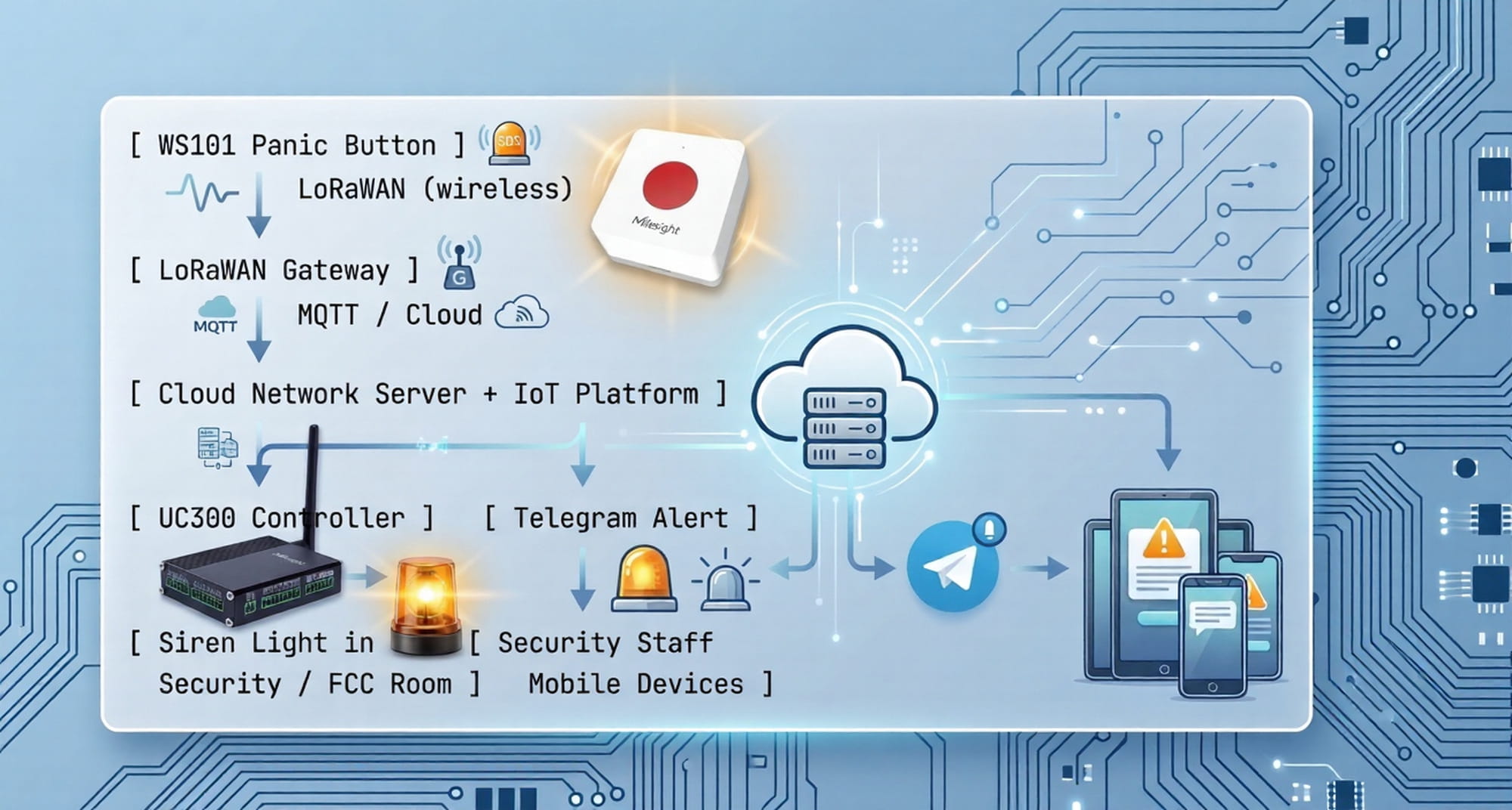
NexAscent’s panic button system brings together four key components into a seamless emergency response workflow.
-
The WS101 Wireless Panic Button
The Milesight WS101 is a compact, wall-mounted LoRaWAN wireless emergency button designed for discreet installation in patient-facing areas. In this deployment, WS101 units are placed in:
- Handicapped-accessible toilets — a high-risk area where falls and medical emergencies frequently go undetected
- Private patient bedrooms — positioned within easy reach of the bed or sitting area
- Bedroom living areas — covering lounge or rest zones within private suites
The WS101 communicates over LoRaWAN — a low-power wide-area wireless protocol. This makes it reliable in complex indoor environments such as hospitals with thick concrete walls and significant RF interference from medical equipment. Batteries typically last several years, eliminating the need for wired power runs.
-
The LoRaWAN Gateway and Cloud Network Server
WS101 button presses are transmitted wirelessly to a LoRaWAN gateway deployed on-site. The gateway forwards all device data to a cloud-hosted network server, where payloads are decoded and processed in real time. Every button press event is timestamped, logged, and routed for downstream action.
This cloud-first architecture means that facility managers can access event logs, device health status, and historical incident reports from anywhere — whether on-site or remotely.
-
The UC300 IoT Controller: Triggering the Physical Siren
Receiving a signal from the cloud, the Milesight UC300 IoT controller acts as the bridge between the digital alert and the physical world. The UC300 is a DIN-rail-mounted industrial controller with configurable digital outputs, making it well-suited for deployment inside a security room or Fire Command Centre (FCC).
When a panic button event is received, the UC300 activates its relay output to trigger an audible and visual siren light installed in the security or FCC room. This ensures that security personnel on duty receive an immediate, unmistakable physical alert — not just a notification buried in a smartphone app.
The siren light provides both an audio alarm and a visual indicator, allowing operators to identify an active emergency even in a noisy environment. The specific room and zone associated with the triggered button can be displayed on a co-located operator dashboard, enabling guards to respond to the exact location without delay.
-
Real-Time Cloud Dashboard and Telegram Alerts
In parallel with the physical siren, the system pushes an instant Telegram message alert to designated security staff and facility managers. The alert contains:
- The button identifier and location (e.g., “Unit 3B — Handicapped Toilet”)
- The timestamp of the event
- A direct link to the operator dashboard for further details
This dual-channel approach ensures no alert goes unnoticed. Whether the security officer is at their post or on patrol, the physical siren and Telegram notification together guarantee a response.
All event data is stored in the cloud, providing a complete, auditable incident log for compliance, insurance, and post-incident review purposes.
System Architecture at a Glance
Why This Architecture Works for Care Facilities
Wireless and minimally disruptive. LoRaWAN-based devices require no new cabling, which is critical in operational care facilities where renovation work is disruptive to patients and expensive to execute.
Reliable in challenging RF environments. LoRaWAN’s sub-GHz frequencies penetrate concrete walls and floors more effectively than Wi-Fi or Bluetooth, making it well-suited to multi-storey hospital buildings.
Redundant alerting. The combination of a physical siren and a Telegram push notification means that a missed alert due to a guard stepping away from the desk does not result in a delayed response.
Cloud-logged for accountability. Every button press is timestamped and stored. This creates a defensible audit trail for incident reporting, regulatory compliance, and quality assurance reviews.
Scalable across facilities. The same architecture can be extended to additional zones, floors, or buildings without architectural changes. New WS101 buttons can be onboarded and assigned to zones through the cloud platform.
Rapid deployment. With no civil or electrical works required for the buttons themselves, a full deployment across a ward or floor can typically be completed in a single day.
The NexAscent IoT panic button system is engineered around five principles that address the specific constraints of healthcare environments.
Real-World Application: Private Hospital Wards
Consider a private hospital wing with twelve patient suites, each comprising a bedroom, a sitting area, and an en-suite accessible bathroom. Under a traditional system, installing nurse call points in all three zones of each suite would require significant cabling work and ongoing maintenance of hardwired infrastructure.
With the NexAscent IoT panic button system, each of the three zones receives a WS101 button — battery-powered, adhesively or screw-mounted, and connected wirelessly to the gateway. The UC300 and siren light are installed once in the security room. The cloud platform and Telegram integration are configured in hours, not days.
From the moment of installation, any press of any button immediately triggers the siren in the security room and fires a Telegram message to the on-duty team, identifying the exact room and zone. Response times are measurably reduced. Staff accountability is improved. Patients and their families have greater confidence that help will arrive quickly.
Conclusion: Building Smarter, Safer Facilities
The convergence of LoRaWAN wireless technology, cloud IoT platforms, and consumer-grade messaging apps like Telegram has made it possible to deploy enterprise-grade emergency response systems at a fraction of the traditional cost and installation complexity.
NexAscent’s IoT panic button system demonstrates that modern IoT architecture — when thoughtfully designed and properly integrated — can meaningfully improve safety outcomes in healthcare environments. The system is not simply a technology upgrade. It is a fundamental improvement in how facilities protect their most vulnerable occupants.
For facilities managers, care facilities administrators, and security teams looking to upgrade emergency response infrastructure, this kind of wireless, cloud-connected, multi-alert architecture represents both best practice and an increasingly accessible standard.
For any facility evaluating an IoT panic button system, the wireless LoRaWAN architecture offers a clear deployment advantage over legacy wired alternatives.
Interested in deploying a smart emergency response system in your facility? Contact NexAscent at nexascent.com to discuss your requirements.