Types of People Counters: 7 Sensors Compared

Types of People Counters: How to Choose the Right Sensor for Buildings, Events and Footfall Analytics
Choosing between the types of people counters is less about finding the “best” sensor than about matching the technology to the entrance, the environment and the decision the data must support. A sensor that works well at a narrow office door can struggle in a wide, high-ceilinged atrium. One that suits an air-conditioned lobby will not survive a rain-exposed street frontage.
This guide explains how the main people counting technologies work and compares seven Milesight models that cover most real-world scenarios. It also shows which ones suit building owners, event organisers and advertisers who need dependable footfall data.
What Is a People Counter, and Why Does the Type Matter?
A people counter (also called a footfall counter or visitor counter) is a sensor mounted at an entrance or passage. It counts the people crossing in each direction and sends the numbers to a dashboard.
The type matters because each technology has different limits. Mounting height, the width a single sensor can cover, tolerance for heat, sunlight or darkness, power requirements and accuracy all vary. Choosing on price alone is the most common reason a footfall project underdelivers.
The Main Types of People Counters and How They Work
-
PIR (passive infrared) sensors
PIR sensors detect the movement of body heat. The Milesight VS350 is a battery-powered LoRaWAN PIR counter for ceilings of 2 to 3 m, with a wall-mount option at 1.2 to 1.3 m. Vendor lab figures put battery life at roughly 4.6 to 9.7 years, depending on LoRaWAN settings. Stated accuracy is about 80%.
The trade-off is temperature. It performs best between 15 and 30°C, and range and accuracy fall as ambient temperature rises. PIR suits air-conditioned indoor doorways, corridors and meeting rooms rather than warm, non-air-conditioned areas.
-
Radar with thermopile sensors
The VS351 combines radar with a thermopile for higher accuracy, up to 90% as stated by the vendor, at ceiling heights of 2 to 3 m. It comes in a battery version or a USB-C powered version. Battery life is about 1.6 to 1.7 years at a 30-minute reporting interval, so plan for power access or more frequent battery changes than with PIR.
-
Infrared breakbeam sensors
The VS360 uses a master unit and a node unit mounted on either side of a passage, 0.7 to 1.2 m above the floor, with a gap of 1.2 to 3 m. It needs no ceiling mounting, runs up to 3 years on a standard ER14505 battery, and is not affected by ambient temperature. That makes it useful where ceilings are too high or unsuitable for a sensor.
Keep it away from direct sunlight, glass and nearby infrared remotes. Beam-based counting can also under-count when people walk shoulder to shoulder, so it works best on narrower passages. Stated accuracy is up to 80%.
-
Camera-based (2D) sensors
The VS121 uses an on-device camera at 2.3 to 4 m, with an optimum of 3 m for line-crossing counts. It offers LoRaWAN or PoE connectivity and stated accuracy of up to 95%. At 4 m it covers an area of about 19.3 × 8.3 m, which makes it a mid-priced option for wider passages.
-
Dual-camera AI stereo vision sensors
The VS125 uses two cameras to build a depth view of the scene, and AI to separate people from objects. It works from 2.2 to 6 m, covers up to 10.4 × 6.0 m at 6 m, and works in low light and darkness. Stated accuracy is up to 99.8%. It connects over PoE or 4G, and a LoRaWAN variant (VS125-LW) suits lower ceilings of 1.9 to 3.5 m.
An outdoor version is rated IP67 for -30 to 65°C, with protection against rain and IR/UV. It is one of the few options here for open-air locations.
-
Time-of-Flight (ToF) with AI sensors
The VS135 uses second-generation ToF depth sensing with AI. It suits ceilings up to 3.5 m, or up to 6.5 m in its high-ceiling configuration. Stated accuracy is up to 99.8%, and it offers LoRaWAN or PoE connectivity. Its coverage area is smaller than the stereo-vision sensor’s (5.5 × 4.0 m at 6.5 m), so wide entrances may need several units. It is a strong choice for tall doorways, atriums and lobbies where accuracy matters most.
Types of People Counters Compared at a Glance
The table below summarises the types of people counters covered in this guide.
| Model | Technology | Mounting height | Connectivity | Stated accuracy* | Environment | Relative cost |
| VS350 | PIR | Ceiling 2–3 m; wall 1.2–1.3 m | LoRaWAN (battery) | ~80% | Indoor, IP30 | Entry |
| VS351 | Radar + thermopile | 2–3 m | LoRaWAN (battery or USB-C) | Up to 90% | Indoor, IP30 | Low–mid |
| VS360 | IR breakbeam | Side-mounted 0.7–1.2 m | LoRaWAN (battery) | Up to 80% | Indoor, IP30 | Low–mid |
| VS121 | 2D camera | 2.3–4 m | LoRaWAN or PoE | Up to 95% | Indoor, IP30 | Mid |
| VS125 | Dual-camera AI stereo vision | 2.2–6 m | PoE or 4G | Up to 99.8% | Indoor, IP40; low light OK | Upper-mid |
| VS135 | ToF + AI | Up to 3.5 m (6.5 m high-ceiling) | LoRaWAN or PoE | Up to 99.8% | Indoor, IP40; low light OK | Premium |
| VS125 Outdoor | Dual-camera AI stereo vision | 2.2–6 m | PoE or 4G | Up to 99.8% | Outdoor, IP67 | Premium |
*Accuracy figures are manufacturer-stated best cases. Real-world results depend on installation height, entrance layout and traffic patterns. Battery life figures are vendor lab results at 25°C and 1,000 people per day. Source: Milesight datasheets and product documentation.
Best People Counters for Building Owners
Building owners typically use people counting data for four purposes:
- Adjusting HVAC and lighting to actual occupancy.
- Understanding space utilisation.
- Reporting visitor volumes to tenants and management.
- Supporting energy and sustainability initiatives with measured data.
For building owners, the right types of people counters depend mainly on whether you can run cables.
- Existing buildings, no new cabling: Battery-powered LoRaWAN sensors (VS350, VS351, VS360) can be installed quickly, suit office doors, corridors and meeting rooms, and avoid ceiling works. Choose the VS360 where a ceiling mount isn’t practical, and the VS351 where you can power it for better accuracy.
- Main lobbies and high-traffic entrances: PoE sensors (VS125, VS135) give the highest accuracy, run from a single cable, and certain PoE models offer BACnet/IP for BMS integration. Wired power also removes battery maintenance across a large portfolio.
- High ceilings and atriums: The VS135 in high-ceiling configuration, or the VS125 at up to 6 m, are the practical options.
Best People Counters for Event Organisers
Event organisers want to know how many people attended, when they arrived, and how crowded each zone got. Sponsors increasingly ask for the same numbers. Events add constraints that buildings don’t: temporary installation, variable ceiling heights, uncertain network coverage and sometimes open-air sites.
- Halls and exhibition spaces with high ceilings: The VS125 handles heights up to 6 m and wide entrances with fewer devices.
- Tents, booths and low-ceiling temporary spaces: Battery LoRaWAN sensors (VS350, VS351) avoid cabling. The VS360 can be mounted on posts or barriers at entry points, but only indoors and out of direct sunlight.
- Outdoor festivals and street events: The VS125 Outdoor is the suitable option. Its 4G connectivity means it doesn’t depend on venue networks, although it still needs power (PoE or 12V DC).
Not every one of these types of people counters suits a temporary installation. Two limits to plan for. First, battery LoRaWAN sensors report at intervals of minutes, not seconds, so use wired sensors where you need live capacity control for safety. Second, a people counter measures headcount, not unique individuals: someone who leaves and returns is counted twice. Combine counter data with ticketing or registration data for a fuller picture. Our occupancy analytics platform offers dedicated modes for facilities and events.
Best Footfall Counters for Advertisers and Media Owners
Advertisers, media owners and retail landlords use footfall to compare locations, set rates for ad spaces and measure the effect of campaigns. Because these numbers are monetised, accuracy and consistency matter more than in most other use cases. Of the types of people counters covered here, only the weather-rated stereo vision model is designed for open frontages.
- Street-level and open frontages: The VS125 Outdoor combines high stated accuracy with IP67 protection.
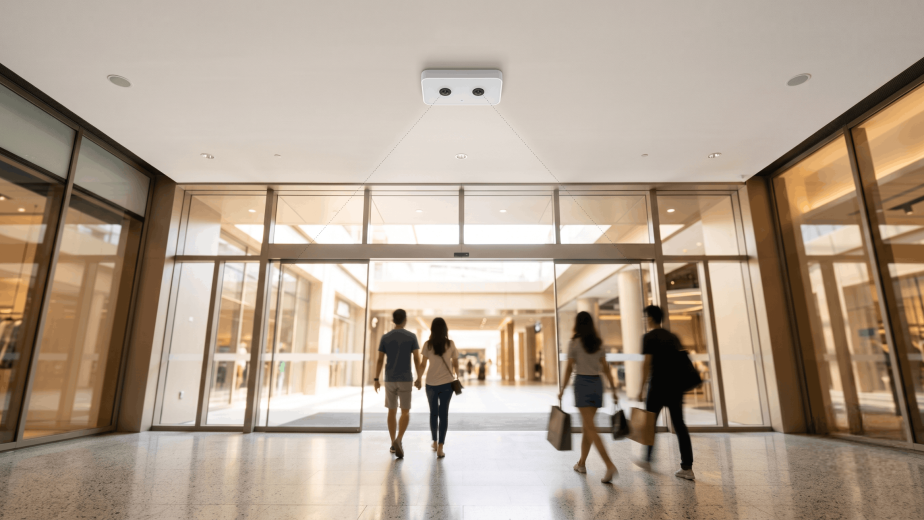
- Mall entrances and atriums: The VS125 or VS135 indoors, depending on ceiling height and entrance width.
- Method: Run a manual count for 30 to 60 minutes at installation and compare it with the sensor’s output. Recording that calibration gives you a defensible methodology when you report footfall to clients.
One caution is worth stating plainly. Footfall is not ad exposure. A people counter tells you how many people passed or entered, not how many looked at an ad. Treat it as the audience-volume layer, and pair it with placement analysis and dwell-time data if you need to estimate attention.
Counting Entrances vs. Measuring Occupancy
his distinction affects what your numbers mean, whichever of the types of people counters you choose.
- Enclosed spaces: If every entrance and exit is covered, total in minus total out gives a true occupancy count.
- Open spaces: If only the main entrance is monitored, in minus out is a net-flow figure. It is a useful traffic indicator, but it is not a true occupancy count.
Reporting net flow as occupancy is a common mistake and worth avoiding in any client-facing dashboard.
Six Questions to Ask Before Choosing Between Types of People Counters
- What is the mounting height and entrance width? Every model has a working range. Measure before you specify.
- Indoor or outdoor? Only IP67-rated models are designed for outdoor use.
- Can you run power and network cabling? If not, battery LoRaWAN is the practical route, with the trade-offs above.
- How accurate must the data be? Operational trends tolerate lower accuracy than billing or sponsor reporting.
- How often do you need the data? Battery sensors trade reporting frequency for lifespan.
- What are the privacy requirements? Non-camera sensors capture no images. For camera-based models, confirm how data is processed and stored, and review your obligations under Singapore’s PDPA.
Frequently Asked Questions
What is the most accurate of the types of people counters?
Based on manufacturer specifications, stereo vision (VS125) and ToF (VS135) sensors are the most accurate, at up to 99.8%. PIR and breakbeam sensors are stated at up to about 80%. Actual accuracy always depends on installation.
Battery or PoE: which is better?
PoE suits entrances with high traffic and where you need frequent or real-time data. Battery LoRaWAN suits places where cabling is impractical and reporting every few minutes is acceptable.
Can people counters work in the dark?
Yes. The VS125, VS135 and VS125 Outdoor are specified to work in low light and darkness.
Can people counters be used outdoors?
Only weather-rated models. The VS125 Outdoor is rated IP67 for temperatures from -30 to 65°C.
Choose the Right People Counter with NexAscent
NexAscent helps building owners, event organisers and media owners select, install and analyse people counting data, from single doors to multi-entrance sites. Contact us with your entrance dimensions and use case, and we’ll recommend which of the types of people counters fits.